Showing posts with label That One Time In France. Show all posts

18 February 2015

"Dear Food Thoughtz:" Too Close for Comfort

Dear Food Thoughtz

Today was my office Christmas potluck luncheon. It was primarily meat and cheese: meatballs, macaroni and cheese, two meat and cheese plates, and a quiche made with cheese and bacon. I brought homemade eatmore bars. They didn't have meat or cheese in them.

Mid-way through our festivities, my officemate got up for seconds, which included a single meatball, and an eatmore square. She put them on the plate together. Oh my god they were so close together. I've attached a picture of the plate, and her reaction as we all shamed her.

My question is: do you think I should request a new officemate?

Sincerely,
Perturbed potlucker

PS she's from France. 


Dear PP,

First of all, apologies for my late response. The good news is that it's never too late to request a new officemate. The bad news is evident in the above photograph.

I must admit, I have a bit of a problem with what you identified as the primary issue here. The problem isn't really that she put the meatball and the eatmore bar on the same plate (and indeed they are treacherously close), but that the plate was already used before she put the eatmore bar on it, and that it was used to hold very messy foods (presumably from previous meatballs), and that those messy foods left a pool of, what appears to be, sweet-and-sour sauce. Or barbeque sauce. Frankly, I don't know the difference.

The weirdest thing here, for me, is that things like eatmore bars don't even need to go on a plate. Like, why risk it? Who likes to live on the edge like this? It's entirely acceptable to cup it in your hand, blanketed in a napkin. Or even without the napkin. It doesn't matter. It's a snack made to be eaten by hand! It just doesn't make sense! That she's French just further obscures things! I thought they were responsible and refined, if in nothing else, at least in food and dining etiquette.

But kudos to your for bringing homemade eatmore bars. I am so sick and tired of cheese plates. Not only will I not eat 99% of the cheese featured on them, the cheddar--which is obviously the only cheese I would eat--is always kind of sweaty. So gross.

Ultimately I think, no, you shouldn't request a new officemate. Seize this opportunity to enrich the life of another human being by continuously shaming her for being so disgusting. Sooner or later she'll learn.

20 December 2014

Food Thoughtz Restaurant Review: Playa Cabana - Hacienda (4)

M just whipped up these crepes/palacsinta to satisfy my hunger and my rage. But I will not be silenced and I will not be placated.


21 October 2014

Mustard

It goes without saying that the views expressed here do not represent my own. Mustard is disgusting. I found out that I used to eat mustard-glazed hams, but now I don't do that anymore.

If living with Food Thoughtz has taught me anything it was that I can't do things my way. It has also taught me some things on the mysterious and sacred nature of tea- and other towels, but that is a subject that should be tackled on my own blog, where I discuss the wonders and mysteries of the created and the eternal world.

Point is that Food Thoughtz has been tugging at my ear until I just gave up resistance, sighed and sat down to my computer to compose an essay on the genera and species of mustards. I love mustard and hot sauce, and condiments in general, especially if you count yogurt as a condiment. (FYI: I do) Although my parents' came from fairly different backgrounds they have always agreed about one thing: dry food is for fools. When I was a kid, we used to eat deep-fried things (I don't anymore, and neither does my sister and my mum. My dad does, but maybe that is the reason why he divorced my mum and married someone who is fond of schnitzels.), but always combined with something juicy or creamy. If we had schnitzels, we had them with mashed potatoes, if we had croquettes, or fried potatoes there was always some kind of sauce or condiment to balance dryness and crunchiness. Later on, when my sister and I went through adolescence we have discovered that the addition of yogurt enhances the quality of EVERY SINGLE dish. It was also around this time that I have discovered mustard and horseradish, and ten years later I have completed my gastronomical education by embracing hot sauce. 

This post is solely about mustard and the different kinds of it, I might write a review on hot sauce in five years, when Food Thoughtz has accumulated a sufficient amount of CAD to buy me a variety of them.

Plain old mustard


I am the direct descendent of a man who ate baloney, bread, mustard and mayonnaise horseradish for dinner every day, for fifteen years, while watching this.

At first I thought my grandpa's choice of dinner was somewhat boring and not very nutritious, but after having lived with him for three years, I have accustomed to his diet, and I would eat baloney with horseradish and mustard any time! Or maybe the love for baloney, mustard and horseradish was already in my genes? Nature vs. nurture! I'll let you decide.

Anyway, my grandpa always bought plain old Univer mustard, which is an excellent choice. It's not cheap store-brand grade mustard, which has most probably been died yellow by sulphur-dioxide or something, but it isn't too expensive to eat with suspicious-looking baloney either. Univer as the name says is universal, and can be put in everything to improve its quality.

Hot recipe tip: Mix it with yogurt, salt and a pinch of sugar, and dip some carrots and apples in it. Also put it in your béchamel sauce, along with nutmeg. Use it to marinate beef. Eat it with boiled beef and vegetables. I could go on....

Dijon mustard


At home, we call Dijon mustard the variety with coarsely ground grains. But one thing the I have learned as a French major was that us Hungarians are fond of naming foods inaccurately.
Hungarians hold a grudge against France because of the treaty of Trianon, and they took their revenge by naming baloney "Parisian" and a gross mayonnaise-covered steamed vegetable medley "French salad" (known as macédoine by the French). Anyway, the coarsely ground mustard (moûtarde à l'ancienne) is not the Dijon mustard, actually it is called old-fashioned mustard by the French, and just one among the varieties of Dijon mustards, which are instead characterized by the addition of white wine. The more you know.*


Dijon mustard is actually my favourite. It is the perfect mixture of heat, saltiness and tartness. It's delicious, it complements pork, beef and cold cuts perfectly. It's so good that you should not use it as an ingredient but as a condiment unto itself, or just serve it as dessert. Desserts are a waste of time anyway.

Hot recipe tip: eat it with a spoon. Put it on everything.

*I have discovered the true nature of French mustard around the time I have discovered my unending love for it, upon devouring a whole jar of Wendy's Maille mustard. Thank you, Wendy for the time I got to spend in your house and your fridge + and for buying me an extra bottle of Maille before my arrival to Canada this year. I don't think I would ever buy it for myself, so really, this post could have never been written without your contribution.

Sweet mustard


Sweet mustards are quite disgusting. Mostly because they are sweet. Sweetness belongs with fruits, drinks and desserts, it has no business in bread, meat and vegetables or mustard.

The Bavarian sweet mustard is apparently based on the idea of substituting sugar for vinegar as a means of preservation. Well, why would you do that, when you could have just used vinegar, or wine? As far as I know vinegar is actually just sugary water in the final stage of rotting, so I assume it must also be cheaper than sugar. It makes no sense whatsoever, unless Bavarians were just too lazy to mix the sugar with water and then let it rot (which actually makes sense, because they are also too lazy to get up from the table to go pee).

I am not sure whether I had this mustard when I was staying in Germany, but if this was the one I had, then I guess it was OK. It looks like diarrhea, but it's fine with rye bread, tomato and (obviously) baloney.

This President's Choice mustard on the other hand was vile and disgusting, it tasted like a tub of sweet earwax, much like the barbecue sauce that was served at McDonalds in the nineties. I put it on the street, because I assume that people in need need nothing more than a tub of earwax. Something like that will greatly enhance the quality of the actual food they already have.

Hot recipe tip
: Avoid it.

Flavoured mustard


Why do you want to improve something that is already perfect? You cannot. (cf. Republic 381b-c, this is why Christians later denied that God actually got mad at Adam and Eve or at the idolatrous and faithless israelites) What is even worse, while you cannot spoil God, you can spoil mustard with your foolish attempts. Just don't do it. (Maybe redcurrant mustard would be nice, though? Just a thought. Cooking is not theology there are no strict rules.)

I guess honey mustard flavouring is OK.

Hot recipe tip: Re-gift it to someone who likes arugula and dark chocolate with chilli.

23 August 2014

Häagen-Dazs Ice Cream

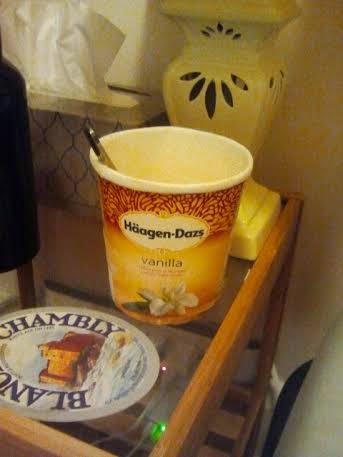
Last summer I was in Overwaitea (obviously) and saw two German tourists in the check-out line with a basket overflowing with Häagen-Dazs. It wasn’t even on sale. Häagen-Dazs isn’t even German. They were traveling and it seemed unlikely they would be able to consume so much Häagen-Dazs before moving on. Nothing made sense.

Here's this tub of Häagen-Dazs that I'm currently eating.
I've always wanted to know what it feels like to lay in bed,
eating a tub of ice cream, while watching TV and crying
about everything that's wrong in my life. It feels fine, but
I don't understand why this is such a popular trope.


I have long maintained that Häagen-Dazs is not all it’s cracked up to be. Sure, it’s decent ice cream, but by no means does its quality justify its price. A tiny little tub of Häagen-Dazs—and let’s be real for a moment, one of those tubs is really only good for one serving—is not worth $7. Especially when the Colville WalMart is right across the line and sells Tillamook ice cream (which truly is quality ice cream) for about $1 a gallon. Sure, it’s an American dollar, but still.

My mum bought a tub of Häagen-Dazs on sale to accompany my birthday pie. And first of all, even on sale it was still $5. Is anyone actually buying this product at full price? But second of all, it just reminded me of how while Häagen-Dazs does make a good ice cream, it likely will never be good enough to warrant that outrageous price. Ice cream can be a tricky product. Some ice cream is truly terrible. Cheap Breyers is probably the worst ice cream on the market, and I don’t think it’s even a dairy product. They would probably be more successful peddling their garbage discount ice cream as vegan rather then trying to pass it off as an ice cream fit for consumption. So, yes. Häagen-Dazs is better than Breyers. But it’s not better than Chapman’s, or President’s Choice, or no-name/sans-nom. I’m not really going anywhere with this. I just don’t think that Häagen-Dazs deserves all the hype it gets.

A seven dollar price tag is practically thieving,
And that umlauted “A” is pretty deceiving—
It took me several years to determine
That Häagen-Dazs isn’t even German.

16 April 2014

Snails

I don’t know why I’m picking on the French (and the Quebecois--I forgot about that poutine post) so much lately, but I can’t even fathom what a people must collectively have to go through to bring them to a point where they would be willing to suck a snail out of its shell—and then turn around and call it a delicacy. I have so little idea, in fact, that I had to ask Yahoo! One person’s response was that it’s no worse than eating clams, oysters, or lobsters. Right. Exactly. It’s not any worse than that. But nor is it any better, and considering that encrusted sea-garbage is just about the worst “edible” thing there is on this planet, that ranks snails as among the worst of the worst.
As much as I hate snails--both as an animal and as a food-- I did
really enjoy putting these snail shells on my back.

One time I was compelled to eat ribs. I have no idea whether or not the meat was any good because I was too overcome by the horror of tearing flesh from the bone. I know that some people talk about sucking marrow from bones, but I'm pretty sure this is just an urban legend, so I can only imagine—but would prefer not to—how much more horrific it would be to actually suck the meat from a chunk of coiled calcium that functions as a skeleton. Do people actually realize that snails are just slugs with shells? Has anyone seen a slug? Because they are vile and horrific beasts, and I used to devote large portions of my summers to hunting slugs with the sole purpose of then throwing them into the ocean.

I don’t know what snails eat, but I’m pretty sure it’s 90% gross slime, 10% garden plants. The snails in our aquarium live off of the algae that develops on the sides of the tank … which is just slime. And then they convert that slime into more slime so that they can transport themselves to richer slime reserves. They are disgusting. In my quest to rid the west coast of its slugs, I had the displeasure of accidentally stepping on a few a couple of times. That slime is the worst. It is sticky and slimy and doesn't come off, and while I have no idea how snails are prepared for eating, if something is not done to rid them of that slime, I can only imagine they are simultaneously lubricated down your throat, but also cling there like sickly, descended tonsils. And speaking of tonsils, if someone removed their tonsils and gave me the option of eating the raw tonsils or a perfectly prepared snail, I'm about 75% sure I would go for the tonsils. Although both are undoubtedly disgusting, only one of them would be a snail.
 Given that snails as a food are so commonly associated with France, it seems like a shame to not draw a correlation between the depravity of the Marquis de Sade and escargot. I don't know how many of you, like me, once had their interest piqued by Sade's extreme commitment to personal freedom and then proceeded to read an online summary of One Hundred and Twenty Days of Sodom only to be so utterly shocked and appalled that you could barely even make it through the summary, but that's how I feel about eating snails: the mere idea of it is so repulsive to me that I can't even begin to imagine actually trying the real thing. Through Sade's commitment to destroy and deprave the body so that he might be free (I have no idea what the Marquis de Sade was trying to do), he probably consumed a whole bunch of snails because few things in this world are a greater assault on the human body than that. There might be something interesting to say here (probably not), but I'm really just trying to get to Simone de Beauvoir's famous question, must we burn Sade? Her answer was a tepid no. A more crucial question might be: Il-faut manger les escargots? Our "no" must be far less tepid.

Snails are treated as a culinary specialty,
But sucking snail-meat from its shell
Is nothing more than a perverse bestiality:
If it doesn’t land you in jail, it will surely land you in hell.

So the next time a gentleman asks you to his chateau,
Remember the one hundred and twenty days of the Marquis de Sade:
A debauched, murderous orgy under a “personal freedom” façade.
The invitation, I’m afraid, you are obligated to forego
And give him instead a rousing escar-hellzno!

13 April 2014

Crème Fraîche

I really need someone to tell me whether or not crème fraîche
is good enough for me to crawl inside of. Because so far,
everything is pointing to yes, and I really want to clamber into a
large bowl of it and simultaneously swim and eat through it.
Please tell me if this is a reasonable reaction to what
seems to be a delicious food.
Readers! Alert! Can someone please tell me what crème fraîche is and whether or not I need it in my life? Because it sounds like I do. It sounds like it’s a thicker version of whipped cream, like sour cream but with less sour. Is it like a better form of Cool Whip? Is this what Cool Whip is based on? Wikipedia tells me that the EU regulates the ingredients of crème fraîche so that it can only be cream and bacterial culture. I love thinking about this branch of the EU. Do you think that this is what France’s role is in the EU? Regulating food ingredients? Because aside from rampant striking, strict food regulation seems to be France’s primary contribution to the world.

But I am serious about crème fraîche. I think this might be something for me. I think I might like to have it with fresh strawberries and maybe a sprinkling of sugar. Is this how it is eaten? Maybe with fresh or canned peaches? Is there something I'm missing? Why is this not whipped cream? Is crème fraîche to cream what yogurt is to milk? Because if so, count me in. That sounds delicious. But I am also afraid of what it might turn out to be. I am afraid it might be too much like sour cream or too... I don't know... French? Because French food can be really tricky. One minute you think it's all delicious pastries and sweets, like pain au chocolat or some delicious fruit-tart, but then you might be cruelly reminded of that gross frozen pea salad made with mayonnaise.

To err on the side of caution, I have labelled this post as "Food I Have Tried But Would Not Try Again," "Food I Will Eat," and "Food I Won't Eat," because at this point it could belong to any one of these three categories. I might have asked for someone to mail me a jar of crème fraîche, but with Canada Post's ludicrous new shipping rates, it would be an unfair financial burden to place on any of my valued readers. If I ever do try this potentially delicious/potentially disgusting new food, I will update the labels accordingly. I might even revamp this post so that it is somewhat relevant.

France fails in many ways--
like in their incessant will to strike--
But when it comes to what to pair with fraises, 
Sometimes even I feel like
I need to re-write my menu afresh
And introduce this mysterious crème fraîche

13 March 2014

Marzipan

I will be the first to admit that I don’t really know what marzipan is, but here is what I do know: I know that it’s sometimes hidden inside of what would otherwise be delicious chocolates; I know that it’s sculpted into elaborate cake decorations; I know that Hungary has dedicated an entire museum to it; and I know that it is made of a ground almond paste, with probably a few other ingredients like sugar and, heaven forbid, coconut.*

Based on this limited yet totally sufficient body of knowledge, I can conclusively say that while I will never eat marzipan, I am kind of drawn to the sculpted figurines.  And herein lies the problem: I don’t particularly like it when I am attracted to one aspect of a food (usually its form) by repulsed by another (usually its taste, or function**). 

Binaries typically provide a great and totally reliable lens through which to view the world, they provide structure and meaning in our lives, and most importantly, they can be used to unpack our troubling relationship with marzipan.  One way to apply the system of binaries is to consider the binary of function/form (even though “form/function” sounds better, I purposely put function before form so you can see how it’s privileged over form).  See how that worked?  Easy as pie!  These days it’s very en vogue to deconstruct binaries—or at least to talk about it a lot—but what these genderqueers don’t realize is that binaries are one of the most useful tools at our disposal when faced with a troublesome entity like marzipan.  If you want to deconstruct something, deconstruct some marzipan and throw out that almond paste.
Ugh. I don't even care about this picture. This entire post fell apart for me in a really big way, actually. If I didn't
value quantity so much more than quality, I definitely would not be posting it at all.

Even though we’ve already agreed that function eclipses form, it’s still worth talking about these confectionary creations because some of them are really elaborate.  It’s possible that I am so fascinated by marzipan sculptures because they come pretty close to that cartoon food realm that I am so enamoured by.  They’re not quite there only because they kind of remind me of claymation, which I am not really into.  They also kind of remind me of those little toys or figurines… I don’t know what they’re called or even how to describe them.  A lot of girls had them when I was little.  They were usually a cute puppy dog and were coated in a soft fuzz.  They also had a weird smell to them, always.  Does anyone know what I am talking about?  I hate those things and have always found them somewhat nauseating. Oh! Here’s a link to them! They are disgusting.

Ugh.  Okay.  Well, that tangent just made it more difficult for me to explain why I do kind of like marzipan aesthetically.  I guess maybe it has something to do with the craftsmanship.  I have no idea how they’re made, but I like to imagine it’s a process similar to blowing glass, which is one of the most fascinating things I’ve ever seen in my life. What I might be realizing through the process of writing this is that I actually do not like marzipan in any capacity. The idea of eating it is, of course, revolting. It must be way too sweet and have grains of sugar and also it’s almond paste. I also don’t understand what happens to a large marzipan sculpture once it has serve its purpose. Surely no one is going to eat 10lbs of marzipan. Do Play-Dough rules apply? Do you just try to separate the colours as best you can and stuff it back into little canisters for next time? I don’t understand. Everything about marzipan seems disgusting and deceiving and wasteful.

Worth mentioning is that at some point in the recent past, there was a rumour of marzipan-made  tiny babies circulating around the internet.  I have no idea how I missed this.  Although it was all a hoax, the truth is perhaps even stranger than fiction: these fit-in-your-palm sculpted newborns are actually created by a Powell River-based artist and sell for over $100, and worse yet, people actually buy these things.  At least one person in this world must have paid money for one of these little gremlins!  Anyway, it got to be enough of a problem that the woman had to include the question of whether or not these things are made from marzipan into her FAQ section.  Even though this marzipan baby myth was debunked, the threat remains.  Marzipan sculpture technique is progressing so rapidly that I fear that one day these will be a reality, and someone will pay money to adorn their baby shower cake with.

Sorry you guys, didn't mean to get up your hopes,
But that miniature basket of fruit is a mazipan-hoax.
Don't gobble up that decorative cake topping in such haste!
Don't you know that it's actually made of almond-paste?


*Update: apparently there is no coconut in marzipan, but if there was some, I really would not be surprised.  The same kinds of people who are into marzipan are probably into shredded coconut.  I have no basis for that accusation, but I’m still pretty certain it’s true.


**One might argue that the function of a food is nourishment, but when you’re dealing with marzipan… come on.

02 February 2014

"Dear Food Thoughtz:" Potato Metaphysics

Welcome to a very special edition of Dear Food Thoughtz.  This question was submitted by a valued reader over a month ago, but because the question demanded a more rigorous examination than I am capable of, I enlisted the help of my personal metaphysician, Midge Deak (pronounced deek).  Midge is a graduate student in philosophy, specializing in Stoic metaphysics.  She has recently solved the problem of identity and is very fond of buns.  As always, please direct all future inquiries to food.thoughtz@gmail.com.  If you require Midge's profound philosophical insights, please put "Philosophy Alert" or "Philosopher Needed" in the subject line. 

Dear Food Thoughtz,

These potatoes were baked, but are they really "baked potatoes"?


Dear Avid Reader, 

First of all, thank you for writing us and for showing an unprecedented interest in the metaphysics of (baked) potatoes. A wise (post-)hellenistic philosopher once said: "Man cannot live by bread alone." And it seems that you, dear reader, cannot live by the substance of potatoes alone; you are hungry for the Baked Potato, or in all probability, pure and unmixed Bakedness.


In order to establish whether a potato that has been baked is a "baked potato", the entity's potatohood and bakedness both ought to be thoroughly investigated. However, putting my own metaphysical interests aside, I will try to focus on your question instead. Namely, what makes a potato a baked potato? Whether any potato that has been baked is a "baked potato" or does "baked potato"-ness consist in something else than going through a structural transformation in an oven.


The question is especially interesting because we actually know of potato dishes that are prepared with the method of baking, but which are not called a (or several) baked potatoes. Examples of such a kind of a dish are "potato squashers", oven-fried potatoes, stuffed potatoes and potato casseroles such as the delicious Hungarian "rakott krumpli" or the less delicious French "tartiflette". 


In my opinion there are two factors that are crucial in a potato-dish naming process (or dish-naming processes in general). First, the different sources that a potato-dish can acquire its name from: (A) non-potato ingredients, e.g. cheesy potatoes (B) other processes of preparation, e.g. stuffed potatoes, (C) some random fantasy name, e.g. tartiflette. And second, the preferences of the potato-dish-baptist. The Baptist could choose a name based on either A, B or C depending on which characteristic of the potato dish she thinks to be the most relevant. If she thinks that the most essential part of a potato dish is that the dish in question has been stuffed, then she will name it a stuffed potato. She may have made this choice because she thinks that the ingredients constituting the stuffing are either made mostly of potato, or that they are not very interesting, at least not more interesting than the gracious act of stuffing. However, if the Baptist feels that the ancillary ingredients have a more crucial importance in defining the essence of the potato-dish in question than the method of preparation, she will name the potato dish with reference to the process involved in preparation. 


It has to be noted that the name-giving preparatory process also has to be chosen from all the different processes involved in the preparation. Baked potatoes are also often washed and scrubbed beforehand, nevertheless they are not called "washed potatoes" or "scrubbed potatoes" or "washed and scrubbed potatoes", or " washed and scrubbed then baked potatoes" even though this last one would be the most accurate description of the potato dish in question. A similar case can be made for naming based on ingredients. Prima facie, these characteristics of potato-dish-naming processes seem to suggest that the christening of a steaming plateful of solanum tuberosum is governed by the whimsical fancies of fallible humans, who just choose whatever name comes to their mind upon the consideration of the material components of the potato dish and its history. This suspicion is also confirmed by the existence of random fantasy names like tartiflette


Personally, I find this account of potato-dish naming highly unsatisfactory. Although most humans are stupid and easily influenced, with the attention span of a tired mosquito, I find it unbelievable that all human actions are dictated by the music of chance. I would like to believe that humans are the most evolved among all animals, and as such have a keen insight into the true nature of things. They see the very essence of things and conceives of them accordingly. Names given to entities reflect this acumen humans have into the nature of things. They aim to grasp the most essential feature of the entities they apply to. To give an example, oranges are called "oranges", because their most essential feature is their colour, which is orange, and tables are called "tables", because their most essential function is to function as a table. If we apply this reasoning to dish naming, we can see that the names of dishes also aim to reflect their true essence. A cheeseburger is essentially cheesy, a Caesar salad is essentially a salad, and a carrot cake is essentially constituted by carrots. In all cases the name reflects the true inner nature.


Based on these considerations, we can conclude that if a potato dish is called "baked potato" it must be a potato dish to which the process of preparation, i.e. baking, is essential. Thus, dear reader, if you ever find yourself asking whether a potato that you have eaten was a "baked potato" close your outer eyes, and focus the eye of your very soul (i.e. your intellect) on the true essential nature of the tuber you have just ingested. Soon you will find an answer.


More tuber musings can be found here.

17 November 2013

The Oyster

One thing I’ve learned about myself over the past twenty-six years is that life—or at least my life—will never be worth the kinds of struggles that are sometimes asked of us and that I do not have a survival instinct.

Have you ever wondered about how we’ve learned that certain foods are okay to eat and that some are not?  I mean, trial and error, I guess.  But have you ever wondered about what kind of person is desperate enough for food that they’re willing to scrape an oyster up off the ocean floor, hold that craggy mound in their hand, smash it against a rock, and then slurp out whatever is inside?  And then, once they’ve done it and realized it didn’t kill them, just do it again for pleasure?  Because if I was ever in the situation where I was stranded by the sea with nothing to eat and I had absolutely no knowledge of what I could eat, I don’t think I’d be going for what I have always equated with the ocean’s waste.  Or even if I did know what I could eat, and I knew that one of those things was an oyster, I think I would just say no thank you, because no matter how hard or painful it may be to die of starvation, I know in my heart of hearts that it hasn’t got anything on trying to swallow a moist, fleshy mass that lives on the ocean floor all day and filters seawater.  Also, I wouldn’t say “thank you,” because being offered an oyster is not something to be thankful for.

My hatred and disgust of oysters might be linked to my mistrust and fear of the ocean.  The question of what I would do if I was on a sinking ship has been asked of me a surprising number of times, and when someone for some reason fails to ask me this question, I will often volunteer the answer because I think it really speaks to the kind of person I am.  The answer is that I would kill myself.  Immediately.  Even if there was a 99% chance of being saved, I would kill myself before I hit the water.  Even if there was a 100% chance of being saved but it meant spending even 30minutes in the ocean, I would kill myself.  Because I can’t think of anything worse than spending time out in the middle of the ocean, hoping that someone would eventually rescue me and risk being brushed up against by a giant squid or nibbled at by some fish.

You guys! Here I am, making gifs! I
probably could have come up with
something more oyster related, but
frankly, oysters aren't really the most
gif-able creatures.
The possibility of actually dying in the ocean and having my water-logged corpse slowly float to the ocean floor while various sea creatures nibble at my decaying flesh that is waving openly in the ocean’s salty depths like so many anemone fingers swaying in a current is abhorrent.  Of course, if I killed myself on a boat I would still meet the same fate.  I am hopeful that adrenaline would take over and I wouldn’t have time to think about it before I died, whereas if I was bobbing around in the ocean, I would be forced to confront what would happen to me after I died.

It’s seems unnecessary to now talk about whether or not I would ever eat one of these briny pockets of phlegm.  The answer is no.  Like, absolutely never.  Remember when I just said that I would commit suicide if I was on a sinking ship?  I think I might actually do the same if I was faced with eating an oyster.  Sometimes when I watch movies or tv shows that have torture scenes, and there’s always someone jamming a sharp object under another person’s fingernails or branding them or whatever, I always take a minute to pray that 1) I will never be the victim of torture, or 2) that whoever is torturing me will not find out about how I feel about oysters, because nothing would pain me more than having to eat an oyster.  Which is why I am writing it down on this blog right now (because I can be certain that absolutely no one will read it).

Maybe I don’t have any authority on what an oyster tastes like, but what I do know is that oysters are nothing more than a small blobs of flesh that live in  gnarled, knobbly shells, and that they do little more than filter sea water all day.  I’m going to go ahead and assume that they taste like the ocean at low-tide.  But an ocean taste that is palpable and fleshy.  And that some people willingly eat, probably because they are perverted and deeply disturbed masochists. 
Here's me, crying amongst an oyster bed because that is the only way I would know how to respond to being
surrounded by so many oysters. Plus, I bet it smells so, so bad there.
There’s probably a way to prepare oysters so that they don’t taste like oysters.  Sometimes I think that developing new ways to flavour otherwise disgusting objects would be a worthwhile endeavour.  Like maybe someday someone will develop a new flavour for charcoal.  The texture of charcoal kind of appeals to me because it reminds me of Lucky Charms marshmallows.  But why would you drown out the original flavour of something that by nature has a disgusting and vile texture only to make it more palatable?  It seems like marinating oysters in (garlic?) butter is probably a thing, but whatever you use to mask the taste, you still have to deal with getting that oyster to go down your throat.  The texture is probably the biggest obstacle for me when it comes to oysters (maybe just after my moral aversion to the sea).  You know how sometimes you accidentally swallow a half-congealed blood clot or a particularly viscous clump of mucus?  That's the only thing that I can think of that might be remotely similar to eating an oyster, but I bet an oyster tastes a whole lot worse.

The practice of eating oyster is also really crude.  I don’t know what it is about seafood that makes everyone abandon their etiquette rules, but it’s disgusting.  Are these people actually just bringing a shell to their mouth and then slurping a slab of fleshy muscle down their throat?  Those people are barbaric monsters and they need to stop it.

I typically try to refrain from learning anything about whatever it is I’m writing about because I think that these blog posts should reflect my impressions of food as closely as is possible without being coloured from outside sources.  (This is a general rule that extends to academia as well.)  But I just googled oysters and I learned two things:
  1. They look like a slug somehow managed to get inside of a small, cramped, moist space and then died. And then rotted.  I used to spend entire days collecting slugs only to throw them into the ocean.  I guess now we know what happened to them all.
  2. There is more than one kind of oyster!  Apparently people don’t eat oysters that produce pearls, but I don’t understand why not.  Those pearl-producing oysters are so stupid and deserve to be eaten (even though eating any oyster is a crime against humanity, or at least a crime against my humanity).  If some little grain of sand found its way into my body, I would try to either eject it or absorb it fully.  Probably the last thing I would do is build a larger casing around it.  
For any of you seriously committed to eating oysters, let me just close on this note.  Obsessively worrying about dying in the ocean has convinced me that one day I probably will die in the ocean.  And all those little bits of flesh that are nibbled at by fish and pooped out, and all those little flags of tissue that pull away from the bone and drift through the open water... Those are the things that get filtered through oysters. I mean, probably. I don't know what else oysters eat if they don't just filter sea water.  And my dying wish is that some of my hatred will be bound to those miniscule pieces of fish poo composed of my digested tissue and those little flaps of water-logged corpse-flesh, and that you will spend the rest of your days full of self-loathing and disgust because that it what you deserve.

Finally, here's a quote from Tobias Smollett's The Expedition of Humphry Clinker:

“Of the fish I need say nothing in this hot weather, but that it comes sixty, seventy, fourscore, and a hundred miles by land carriage; a circumstance sufficient, without any comment, to turn a Dutchman’s stomach, even if his nose was not saluted in every alley with the sweet flavor of fresh mackerel, selling by retail. This is not the season for oysters; nevertheless, it may not be amiss to mention that the right Colchester are kept in slime pits, occasionally overflowed by the sea—and that the green color, so much admired by the voluptuaries of this metropolis, is occasioned by the vitriolic scum which rises on the surface of the stagnant and stinking water.”
None of us will ever read this book, but Smollett has a point. 

I’ve never understood why eating an oyster is a privilege to flaunt
Because if the world is my oyster, it’s not a world that I want. 

These people brag about how eating oyster is a sign of refined taste
But what they're slurping down their throat 
is nothing more than discarded sea waste.

14 November 2013

Lucky Charms

I have always loved Lucky Charms cereal — presumably just like every other child always has because it’s not even cereal, just marshmallows and sugar-coated crunchy-pieces that pay lip-service to the idea of “cereal.” When I would have a bowl of Lucky Charms, I would spend twenty minutes painstakingly picking out and eating the cereal bits until I was left with a bowl of marshmallows. The appeal of eating the marshmallows on their own has always been that the marshmallows are firm in their structure, but offer no resistance when you bite into them. There has always been a bit of a thrill in biting a marshmallow and half, and then examining its cross-section. Sometimes I would put a marshmallow—usually a red balloon, because they were my favourite—in my mouth and suck on it until it disintegrated. It’s a different experience than letting chocolate or a popsicle melt in your mouth because you can actually feel individual bits of sugar coming loose from the balloon until nothing is left. These two approaches to eating the marshmallows is contingent on their dryness.
Here's a screenshot of a picture I uploaded to Instagram of the first bowl of Lucky Charms that I ate after buying the
box, including a caption lambasting all of the fools who have eaten Lucky Charms with milk.

Here's a picture of what's left after
picking out the cereal bits.
One time, I think in the summer of 2006, I spent an entire day eating all of the cereal bits so that I could make a ball of all of the marshmallows in a single box of Lucky Charms and bite into it like an apple. It once occurred to me that I should just pick out the marshmallows and throw out the rest, but I realized that one of the best parts is the delayed satisfaction of eating all of those marshmallows all at once. This method of eating Lucky Charms taught me that if you work hard for something, the payoff will be that much sweeter than if you just go straight for the reward. For the record, I have not carried this life philosophy over to any other aspect of my life.

I typically always ate cold cereal dry. Rice Krispies is probably the only cold cereal that I consistently ate with milk (always with sliced up banana and a bit of sugar), and to this day, I have never had Cheerios, Golden Grahams, or Honeycomb cereal in milk. The thought of cereal and milk never disgusted me, but I was always certain that it would take away some crucial element from the cereal. I thought of it as a practice that was widely accepted, but never closely examined. I have always thought that cereal is best when it’s crunchy and that its crunchiness was central to its very identity. While I had often entertained the idea of eating my cereal in milk, I never did because I have always been a firm believer in sticking with what you know and what you know you like. Even if something turns out to be not bad, why waste that one experience when you know for sure that it could be as good as it has always been? For the record, this is a life philosophy that I have carried over to every other aspect of my life.

You can tell this is a store brand cereal
because the flakes are a much lower
quality than I have come to expect
from the branded cereals.
Things began to change when I went to Europe—the land of self-discovery—in 2005. I bought an 8€ box of Special K Red Berries and I had it with milk. Although I had had Special K Red Berries without milk in the past and really enjoyed eating those dried strawberries, after having a bite of my friend’s cereal, I realized that the strawberries only improved when they were soaked in milk and had the opportunity to soften up a bit. It was also around this time that I made the crucial switch from skim milk to homo, and while I still prefer skim milk for drinking, homo really is the best when it comes to cereal or milk in your coffee. The next cereal I tried in milk was something like NesQuik. It went over really well because on one hand, it turns the milk into chocolate milk, and on the other hand, those chocolate balls were always too dense and too hard to really enjoy. The milk softened them up an appropriate amount.

Ever since, I have been on a bit of a cereal-with-milk tear. As I mentioned, I still eat cereals like Golden Grahams and Cheerios without milk, but I’ve introduced a lot of new and exciting cereals into my repertoire as well—all of which I eat with milk. Over the past few years, I’ve really gotten into Kashi, Vector, Raisin Bran and any cereal that has dried berries in it (Jordans Morning Crisp, Honey Bunches of Oats with Strawberries, or the store-brand take on Special K Red Berries).

Lucky Charms is something that I’ve eaten less and less of over the years. Every once in a while it will go on sale so I’ll pick up a box, but in general, it’s just not a part of my diet anymore. There are probably a few reasons for this. Part of it has to do with how expensive it is, but more importantly, having a bowl of dry cereal has always been a mindless snacking activity for me. I eat it when I am watching tv or doing school work. I don’t want to have to focus on what it is I’m eating, and Lucky Charms is a cereal that, if you’re eating it dry, you have to give it your full attention. So it came as a bit of surprise to me when I picked up a box at Metro the other day (it was on sale for $2.99, down from the usual $5.50), but I was really excited to tuck into it.

At first I ate it as I always have. I poured a bowl, painstakingly picked out and ate the cereal bits, spent some time appreciating the beauty of all the colourful marshmallows alone in the bowl, and then gobbled them up. R was in the kitchen with me at the time and mentioned that his parents would never buy him Lucky Charms, but that sometimes his grandmother would. When I said that I never eat them with milk, he said that he had always enjoyed them with milk and that he would try to eat the cereal bits first because they were best when crunchy, but that the marshmallows really improved when saturated in milk.
On the cusp of trying something new. I regret getting rid of that box
because I could really use a new toque right now.
And then something happened. I don’t know what. I wanted to try it. I poured myself another bowl, added milk, and prepared for the worst. My main concern was that I would have less control over the cereal once it was sloshing around in a bowl of milk. I wouldn’t be able to pick out the cereal bits very easily, and I knew that I would inevitably miss some. I knew, going into it, that there would be times when I would have to eat spoonfuls that contained both cereal and marshmallow, and although I wasn’t thrilled by the idea, something—some force outside myself—urged me on. It will probably come as no surprise that I liked it. I really liked it. I’m still not sure if I like it more than having it dry, but I do like it. I liked it enough to rush out and buy another box to do the whole thing over again.
Something changed in me that day. It wasn’t life altering, but more like a little sliver of doubt entering my consciousness. I was so sure about Lucky Charms. So sure. I knew how I liked it; I was so certain that it could never be better. I’m not sure that it is better, but I think it’s probably just as good. My approach to food has always been premised on a strict hierarchical system. There is a very small group of food that I like, and within that group, I have always been adamant that there is a singular best way to enjoy that food. Potatoes are best fried; pasta is best with bolognese; broccoli and cauliflower are best with cheese. There are, of course, other ways I will eat these foods. I like potatoes baked in an oven or mashed, and I like pasta with either just cheese or sometimes just butter, and I like broccoli and cauliflower steamed plain or with butter, or sometimes even raw. But there is always, always, a “best” way to enjoy these foods. What’s different about Lucky Charms is that I’m worried that I like them with milk as much as I like them plain.

What does that mean for me and my diet? What if postmodernist theory was right? What if there is no such thing as a singular truth? That it’s all a construction? That there’s more than one approach to something, and that one is not necessarily more valuable than another? It’s an exciting time in my life right now, but also frightening. Does my experience with Lucky Charms gesture towards a flattening out of my diet, a horizontal expansion that knows no bounds? And where will I go from here? How will I ever approach a box of Lucky Charms ever again? How will I know how to eat it? How can I ever be certain of what I want ever again? The future is marred by uncertainty, and I have never been more afraid in my entire life.
Ever since it happened, news has spread like wildfire throughout Toronto.


I've approached my diet with unflinching certainty:
Confidence in my taste is central to my identity.
To experiment with food was an impossibility,
And Lucky Charms with milk was an incomprehensibility.

That I liked it suggests potential dietary malleability,
And more frighteningly yet, that singular truth is a fragility. 
What if trying new things is within my capability?
Does this signal towards a new versatility?

02 October 2013

Salted Caramel

I don’t even know when salted caramel started being a thing, but I’m so glad it’s happening right now and that I got into the trend early enough so that years from now I can look back fondly and say, “I was there.”

I don’t know enough about salt, caramel, or salted caramel to really comment too deeply on this, but it’s relevant to the previous burger disaster because the free milkshake we received was chocolate and salted caramel, and it really helped to remind me that there’s still beauty in this world.

Do you guys even know how good salted caramel is?  It is so good.  My mum sent two of those big bars of President’s Chocolate last year for Christmas, and one of them was salted caramel.  First of all, I really love those President’s Choice chocolate bars.  I think the packaging is really nice, but I’ve also never been disappointed with the quality.  I like the dark chocolate because it’s dark without being too dark, and I really like the milk chocolate and hazelnut, although I don’t eat it as often because milk chocolate can be a lot to take in sometimes.  Anyway, one of the bars was just the run-of-the-mill dark chocolate, but the other one was this salted caramel bar.  When I saw it I thought, no, I’m not going to eat this. If eating one of those Nature’s Valley granola bars has taught me anything, it’s that I don’t like sweet and salty together.

But in a fit of desperation for something sweet, I did try it, and I’ve never looked back.  Since then the only salted caramel product I’ve had is ice cream, and it’s even better than the PC chocolate bar.  By the way, the salted caramel flavour for PC chocolate bars might be only seasonal, and might only be in B.C. — at least it wasn’t available in Montreal last year at Christmas (although that’s hardly surprising because a lot of things aren’t available in Quebec).

How else to wash down a disgusting patty of raw beef
Than with a salty-caramel milkshake digestif?

26 September 2013

These Weird Chocolate Mushroom Shaped Biscuits

If the purpose of this blog is to create and maintain a catalogue of all the foods I have encountered, and a brief note on whether I will eat (or will eat again) that food, then let this post be one loud, resounding YES!!!

I bought these tasty treats in Lethbridge, Alberta.  I know what you’re thinking: Alberta? Lethbridge?  When did Alberta—let alone the rural southern part of Alberta—become such a trendsetter and the epicentre of novelty foodstuffs vaguely resembling non-novelty foodstuffs?  The easy answer is whenever the Real Canadian Superstore opened in Lethbridge, but the more accurate answer is whenever the Asian market found out about southern Alberta.


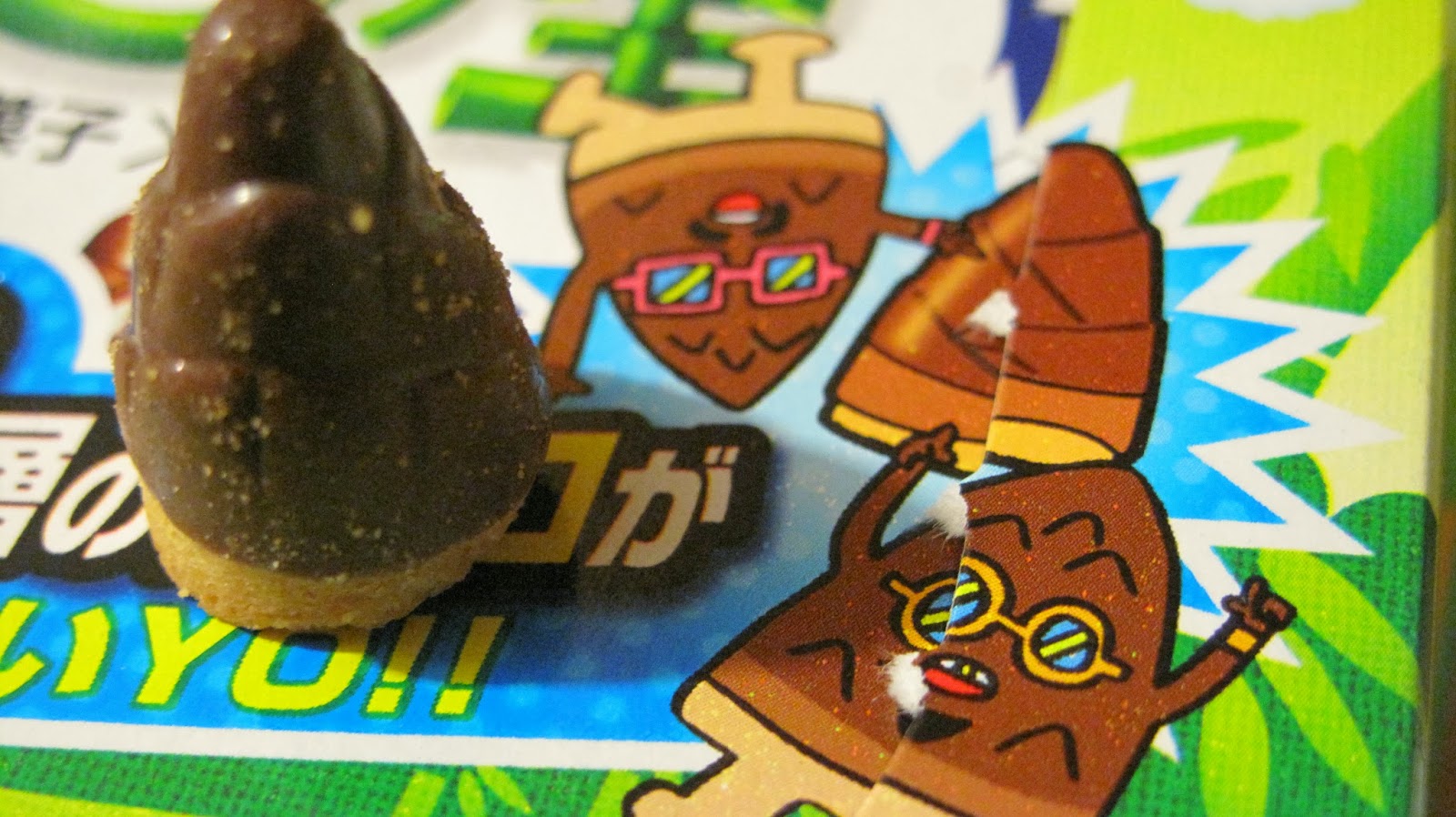
I was tempted to lump this, along with a few other recently discovered gems, under a generic “cartoon food update” header and be done with it.  But there’s something about these ChocoBoy chocolate mushrooms that sets them apart … and I think it’s the chocolate.  These biscuits really
don’t resemble food in the way the gummi burgers did, so I decided to treat them (along with the EveryBurger, coming up soon) separately.  The most important thing to keep in mind, which is something that I hope I stressed in the Cartoon Food post is that cartoon food (I mean that is onTV, not what you can buy in stores) sets a standard for that entire food.  For me, a cartoon mushroom must always be a white mushroom and always be on a pizza.  You know what mushrooms I'm talking about.

There are a lot of things I really liked about this snack.  For starters, I love the milk chocolate and biscuit combination.  It’s a pairing I really got into when I was in France—yes, France—and lived almost exclusively off of those biscuits with a thick layer of milk chocolate on top.   There’s something about the fusion of firm milk chocolate with crunchy biscuit that’s just … so … satisfying.  At first you might think the milk chocolate is too firm, but you would be mistaken.  Pushing down on that chocolately bulb is almost like plunging a French press: you get the same soft compression and slow resistance.  And just as you’re two rows of teeth are getting close to meeting, you snap the brittle biscuit because that tension—albeit slow, and albeit soft—has been building up and is finally released when it comes into contact with the biscuit. 

The second reason I really liked these choco-mushrooms is because they’re shaped like mushrooms.  In terms of balancing the biscuit-chocolate ratio, a mushroom design does make sense: it’s really nice to have all of the chocolate concentrated in one area so that you can decide which part, the chocolate or the biscuit, that you would like to really focus on and savour.  But on the other hand, isn’t it so weird to make a little cookie shaped like a mushroom?  And not even a normal white mushroom, but one of those weird, wild, really phallic mushrooms? Like, what a weird choice for a cookie.  But you know what? It works.  And it especially works for someone like me who would never actually eat a mushroom (or would I?).

The third great thing about this product is the packaging.  I remember going into the Shell when I was younger and being so jealous that they had entire box displays of Baby Bottle Pop or Ring Pop.  Until I realized you could just buy all that stuff in Costco, I really thought that it was a sign of success to have the display box.  These ChocoBoy mushrooms come in a similar display box, but obviously were not designed to be sold in the same way as Ring Pops (in part because there are too few in a box, but also because they’re all just loose in there and that would be disgusting).  At any rate, the packaging was a nice little bonus.  They didn’t have to do that, and you know, I really like when companies say to themselves (or so I imagine), “You know, we really don’t have to do this.  But I tell you what — I bet there’s a little girl out there who’s really going to appreciate it.”  (This is actually how I imagine a lot of businesses working.)  And this goes without saying, but the cartoon versions of the mushrooms on the packaging really wet my appetite.  At first I thought there was no way the real cookies would be anything like the depiction on the box, but then I opened the box and was like, wow, these cookies are really similar to this depiction.

Overall, this was a really positive experience for me.


UPDATE: 
A fellow food hero has already written about these and it turns out the ChocoBoy (a Korean company) chocolate mushrooms are a knock-off of the Japanese Kinoko No Yama cookies, which have been in circulation since 1975 and, according to the author, have been the leader in the "'sweets that look like mushrooms' market."  What is it with all these amazing food blogs lately?


FURTHER UPDATE:

After reading about an entire world of chocolatey biscuits that I didn't even know existed, I used the internet to track down a cache of Japanese snacks.  I discovered that the Korean supermarket a block away also carried Japanese products, and so I hotfooted it over and bought the following:
I also bought a box of the meiji Kinoko No Yama chocolate mushrooms, but they're not in the picture because I
gobbled them up immediately. A picture of the empty package will follow.  From left to right: some Japanese chocolatey biscuit in the shape of what I assume are pinecones (by meiji); some Japanese chocolatey biscuit in the shape of tree trunks (by meiji); a Korean chocolatey biscuit in the shape of koalas and called "Koala's March" (by Lotte).


And here's a picture of meiji's Kinoko No Yama, which I believe translates to "mushroom mountain."

Here are some pictures of the tree stumps:
The interior of the carton is similar to EveryBurger: two foil-wrapped plastic trays full of cookies.  The others only
haveone large foil pouch, which you will see later on.


Here's a closeup of the biscuits themselves.

And now the pinecones:


The opened package.
The individual biscuits.  These were my least favourite of all the snacks, and it definitely had to do with the biscuit
part,which was much more crumbly than the others. It almost had an artificial nutty taste.
The actual biscuit in comparison to how they are presented on the packaging.  I wish they would have included marzipan
facial hair and sunglasses on the actual biscuits.

Last but not least, Koala March:
And finally, Lotte's "Koala March," which I haven't tried yet, but
am really excited to open. Apparently all of the koalas are different,
and there's even an "appendicitis panda," although I believe
it is quite rare.

A brief note on my experiences: The link posted above to serious eats is a taste test between ChocoBoy's mushroom biscuits and meiji's Kinoko No Yama. The taste test revealed ChocoBoy to be the better biscuit, despite a general consensus that Kinoko No Yama is better quality. What sealed the deal in favour of ChocoBoy was the taste of the biscuit, which is a lot sweeter than Kinoko No Yama. My impression is that while both are great, I too must side with ChocoBoy. Unlike the taste testers at serious eats, I didn't really discern any difference in the quality of the two chocolates, but I definitely did prefer the ChocoBoy biscuit stems. One point in favour of Kinoko No Yama (although this might just be an issue of shopping) is that there were fewer broken biscuits.

Next I tried the tree stumps, which taste nearly identical to the meiji mushrooms. I love them for their novelty factor -- seriously, tree stumps? -- but ultimately I preferred the shape of the mushrooms when it comes to actually eating the biscuits. What I don't like about the tree stumps is that you pretty much have to take bites that are both chocolate and biscuit, whereas I like to be the master of my own destiny when it comes to what section of the cookie is in my mouth at what time.

Finally, I tried the pinecones and as I mentioned in one of the photo captions, these were my least favourite. The biscuit was decidedly different from the others, and I didn't enjoy it nearly as much. What I think I would have liked a lot more is if they had made the biscuit a hollow cylinder because I think I would really enjoy lodging the point against the back of my front teeth, and then crushing the pinecone by forcing my tongue into the hollow cookie.

I have yet to try the Koala March biscuits, but it is my understanding that they are merely the Korean version of the meiji pandas, which I have had and which I really, really liked. I've always been a fan of cookies that are chocolate pockets, which is exactly what these are. The added bonus is that each cookie has a printed image of, in this case, a koala. Apparently each koala is different, so I will be sure to update this post with some individual pictures of the biscuits themselves.

And finally, to close things out, here's the poem that was missing from the original post:

So you have a selective eating disorder, what could be worse?
What sins did your parents commit to burden you with this curse?


You won’t eat sandwiches, salads, or fettuccine alfredo.
You won’t eat red pepper, beet, cucumber, or tomato.
But do not despair; there’s more to this world.
There’s the entire Far East just waiting to be unfurled.
Korea has ChocoBoy, the chocolate-capped mushrooms
And Japan has Meiji, with its entire forest in bloom:
Mushrooms, and pinecones, and tree stumps — oh my!
A whole new world of chocolately biscuits for you to try!