Showing posts with label Heart Thoughtz. Show all posts

10 October 2014

Food Thoughtz Emergency

I am currently enrolled in a Master of Information program at the University of Toronto. I am studying to become an archivist. A requirement of the programme is to complete two "workshops," which I had initially assumed would be somehow relevant and practical in nature. I thought that we would work in groups to develop and execute an appraisal plan, or something along those lines. But, never failing to disappoint, the iSchool has upset my assumptions once again. These workshops are largely impractical and could focus on any number of topics--few of which have any direct connection to my area of study.

One such workshop, offered this winter, is entitled "Communicating Identities at the Table." Here is the course description:

This interdisciplinary workshop explores a very popular social and cultural practice, the dinner party, in order to engage students with contemporary discourses about cooking, eating and performing identities through food in both domestic and public spaces. In the past few decades, communication and information about food and culinary cultures intensified in everyday contexts, exposing contemporary communities, globally, to the poetics and politics of food production and consumption. For information students, this workshop will provide a new approach to thinking about the diverse ways in which we communicate and share information about food, foodways and food technologies.
This workshop zooms in on the dinner party, a practice with a rich cultural history, in order to highlight the different forms of communication which make up the current foodscapes. The course introduces students to the social and cultural history of the dinner party, highlighting some significant examples, such as Tupperware parties, underground supper clubs, dinner reenactments and Mad Men-inspired evenings. The focus of the workshop is on how such events are communicated through various media, from magazines and television to apps and blogs. Some examples analyzed in the class are popular television shows–“Dinner party wars” and “Come dine with me, Canada”, movies–“Babette’s feast” (1987), “Big Night” (1996) “Julie & Julia” (2009) and “The hundred-foot journey” (2014) and magazines–Food & Drink, Bon Appétit, Food Network Magazine, etc.

Please note that students will require no specialist knowledge of either food studies or media studies in order to take this workshop, although some background in communication/media theory and/or cultural studies will be helpful. Students will be expected to consume food media relevant to the content of the course and should be aware before enrolling that some food tastings will take place during class time.
[my emphasis]

I repeat: this is a real thing. This is a course I could actually take and get credit for in the coming semester.


What I need to know from you, dear readers, is what course of action I should take in response to this ludicrous class. Should I submit a strongly worded letter about how the iSchool is excluding a small subset of society that may or may not suffer from an undiagnosed and unrecognized--but still conceivably possible and real--eating disorder ("selective eating disorder")? Should I challenge myself and enrol in the course? Should I forget that I ever read this course description? Please advise.

05 March 2014

A Request

I've made a few requests so far on this blog. I asked for one of these Popin' Cookin' DIY Hamburger kit for Christmas, but no one delivered. Now I am asking for this set of four Cadbury "L'il Chocolatey Scoops." I actually need this, so please, somebody: make my dreams come true.
From NearOf (whatever that is):
Much like Terry's Chocolate Orange, this is a participatory treat that requires some thought before and during consumption. Instead of a whack-and-unwrap proposition, these encourage the eater to peel off the wrapper, crack off the top of the shell, and feast on the chocolate mousse filling inside with the help of the enclosed spoon. Super concept.
Aside from the great design, they found the chocolate almost inedible and advised readers not to buy. But still. I need it.

09 February 2014

Valentine's Candy Roundup

If grocery store aisles are any indication (they are), Valentine’s Day has been upon us for quite some time.  But now it’s really upon us, so I thought I would do a Valentine’s Day candy/treats roundup.  I had to take all of these pictures when I was in Loblaws and it was really embarrassing.  It’s probably too late this year, but hopefully this guide will give you a good idea of what to give me next year.  If you can’t be bothered to get through the entire post, the short answer is sugar cookies.

Hershey's chocolate is actually pretty terrible, but I have always loved Hershey's Kisses.  I used to always love their advertisements, probably because almost all of them featured an animated Kiss and I always thought that was cute (and maybe kind of rare?  I can't really think of any other candy advertisements like that).  But they were also a lot of fun to unwrap because you typically only had to pull the paper string to pull the foil off.  They were also the perfect size to pop in your mouth and let melt.  The pointed tip was a fun feature because you could feel it become more and more dull in your mouth until it disappeared all together.


I have never had a chocolate rose, but I love this idea.  The ones in the middle look slightly better than the Toblerones, but probably aren't because they're a cheap unbranded chocolate.  I think Lindt make chocolate roses that more closely resemble the ones in the middle. I just feel like the Toberlone roses really suffer from the cardboard packaging.  I don't know if they're shaped like a rose inside (probably not), but if you're going to market your chocolate this way, it really should look like a rose.


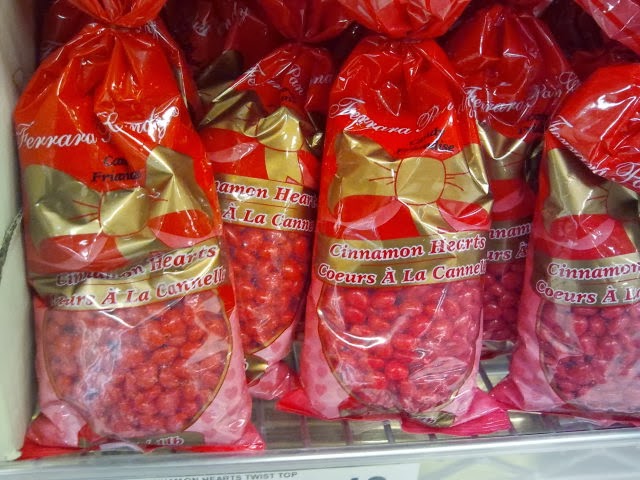
I love Cinnamon Hearts.  They have always been my favourite Valentine's Day candy.  I love stuffing a handful in my mouth at once, sucking on them for a while, and then starting to chew, but because there's so many of them, they form one giant ball and then you just suck the sugar out by filtering your saliva through the candy.  It's amazing.  I also suspect that all of my dental problems can probably be traced back to the first time I was introduced to these candies, but I have no regrets.


By no means do I hate these cheap, generic chocolates that always seem to come in this plastic netting, but it seems like everyone gets this chocolate at every holiday, and it's always the chocolate you put aside and forget about because there's way better candy to eat.  And then a while later you discover it again and resign yourself to eating it because you've already gone through everything else.  And you know what?  It's actually kind of good.


Ferrero Rocher wins every time. Goddamn, these are so good. SO GOOD.  I tend to prefer packaging that you unwrap rather than tear open, and these are perfect because every chocolate is like a little present (and a gift from God).  I also love how easy it is to cut them in half with your teeth, and then to keep one half in your mouth and examine the cross-section of the other half.


I typically like every Lindt product, so I guess these chocolates are fine.  I mean, the chocolates themselves are really good, but one of the best things about Lindt as a company is that they're pretty inventive with their holiday chocolates.  They put out those chocolate bunnies wrapped in gold and those adorable chocolate carrots wrapped in orange, so I always got the impression that this was just left-over chocolate that they didn't know what to do with.


This is a terrible picture, but someone was standing right next to me and I was too embarrassed to reposition the Smarties to get a proper picture.  Anyway, they're just regular Smarties, but they're only red and pink (or would be if Smarties hadn't gotten rid of their artificial colours).  Like the Lindt chocolates above, I've always found this kind of holiday candy to be pretty lazy.  Smarties does a much better job with their heart-shaped boxes, shown below.


Way better, right? There's probably less Smarties in here and it probably costs more, but I like that Nestle made the effort to come out with a Valentine's Day product.  Even though it seems pretty uninspired, I actually really like it because a heart-shaped box full of chocolates is such a traditional Valentine's Day gift.  I also like that they include the e To and From options.  Unfortunately the product itself is no longer edible, so don't get me this please.


Did anyone know that these were called Golden Buds?  I always assumed they were just Rosettes.  Weird.  Anyway, I never really liked these chocolates.  They remind me of the kind of chocolate you might find at Fields.  Probably because the only time I've ever had these, I bought them at Fields.  I've never liked Nielson as a company, and I don't care who knows it.


Okay, so here Lindt is getting a bit more interesting with the small bear and the 4 hearts.  But this, first of all, is tiny, and second of all, really pales in comparison to what they offer at Easter (the chocolate for which, by the way, is also available in stores now).  I wouldn't like to get this for Valentine's Day because it would make me think that whoever gave it to me was not ready to fully commit to our relationship.  Obviously I would still eat it, but I would question their devotion to me.


Okay, here's Lindt upping their game once again.  The one on the left looks pretty interesting, but unfortunately I didn't examine it closer when I was in the store, so who knows what's inside.  It looks like the white box just contains those round balls, which are delicious, so that's great.  But jeeze louise, $10.99?  Here's a hot tip: those Lindt balls are always really cheap at the Dollarama, and they often go on sale at Shopper's Drug Mart.


Nice try, Loblaws, but these President's Choice Mini Chocolate Cupcakes are not even Valentine's Day-specific.  I would guess that they're having a hard time selling these things because they look so disgusting, so they slipped them in here hoping that some fool would buy them.  Ugh.  Who would buy these?  Why wouldn't you get the 2-bite brownies? They're probably so much better than these.  Sometimes PC really drops the ball.


Okay, I know I said that I like Hershey's Kisses, but I would hate it if anyone got this for me.  I think I already mentioned that Hershey's chocolate is pretty bad, but look at this pathetic packaging.  It looks like this was produced by a generic no-name company that decided to try their hand at chocolate and have no idea what their doing or by a company that is losing its edge and is in rapid decline.  I mean, it looks like it could be either, but the truth is that it's the latter.  Tacky, tacky, tacky.


I don't like Reese anything, but I appreciate the effort here.  I can see how someone who really likes Reese would be happy with this.  I guess my only complaint is that unlike the Smarties box, this one is too... I don't know, obviously just a chocolate bar re-purposed for Valentine's Day.  Does that many any sense?  The Smarties box was at least a heart-shaped box, with a lid that you lift off, but this is just, what?  A heart-shaped something-or-other inside of a box?  I don't like the packaging here.


Kinder Surprise is doing a better job with packaging here than Reese, but still a pretty pathetic offering.  I really think that companies should re-imagine their products for holidays, not just put two Kinder Surprise eggs inside of a cardboard heart.  I would hope that at the very least the toys would be Valentine's related, but I bet they're not.  It just shows a lack of dedication.


At first I thought these were those awful chalky hearts in a cardboard box, but they're actually some sort of chocolate.  I say "some sort" because I doubt they're actually chocolate.  They probably are very similar in quality to those fifteen discount advent calendars that I got from my sister for Christmas. The only other thing I have to say about these is that I really hate it when emoticons are used in unnecessary ways.  And "happy v-day"? I hate it. I hate everything about it.


Loblaws didn't actually carry these, and good for them because I hate these chalk-hearts and always have.  I was also always really frustrated by the pathetic messages on them.  "Love You" is fine, but sometimes the messages are so fine.  I think that these days they actually say things like "Text Me."  Text you what?  Text you and tell you that a disgusting chalk-heart told me so but that I was too afraid to eat it because they all look so dirty and old even when their messages are as contemporary as "Text Me"? 


All I want to say as a closing note is that Valentine's is a big chocolate holiday, so I really can't stand it when companies are lazy with their products--mostly because I know that the idiots who buy those products are also lazy with their significant others.  Look, we can't all bake our loved ones a cake and send it to them in the mail, but we can make an effort to buy the most relevant-themed chocolate that is available and to hold these companies to higher standards.

27 January 2014

Pasta - Part I: An Introduction

Dear readers, you might be in for a long haul on this one.  One of the good things about being a picky eater is that on top of avoiding a bunch of really disgusting foods, you will likely become really passionate about the food you do like.  Pasta is one such food for me, and you guys, I really love pasta. 

Probably more than any other food type, pasta has remained the most reliable across time.  I’ve made similar statements about rice and potatoes—both of which are major staples in my diet—but neither have proven to be as consistently delicious or trustworthy throughout my life has pasta has been.  When we would go out for dinner to a restaurant when I was younger, plain pasta with butter was almost always not only a viable option, but one that I took extreme relish in.  There has only been one exception at the Sheraton Hotel in Spokane in which I didn’t get the pasta dish I expected (I touched on it briefly in a Dear Food Thoughtz post), but I see no reason for rehashing that one particular anomaly again here.  As I grew older and as my tastes evolved into the perfected and crystalline state they are today, I began to experiment first with plain tomato sauce and later with bolognese.  Actually, now that I think of it, there was a second incident in which I accidentally ordered a pesto lasagna not realizing what it was, but I take full responsibility for that mistake, and because it was a lasagna, it’s beyond the scope of my present purposes.
You know, I’ve always thought that the Catholic belief in transubstantiation was a bit farfetched, but I’ll be damned if pasta doesn’t transform into something divine when cooked.  Is there a more convenient food on this earth?!  It can be stored forever in its dry form,* but boils into perfectly soft and starchy entity in a short period of time (much shorter than rice, which shares the same storage benefits, although for some reason I always think a mouse will get in there).

  Its quick prep time and long shelf life make it perfect for round-the-clock feasts.  For whatever reason, I have a really hard time measuring pasta quantity, but it ultimately doesn't matter because if you cook too much you'll eat it anyway because it's delicious, and if you cook too little it only takes about 5 minutes to make another batch.

Another great benefit to pasta is that the possibilities of different pasta shapes is limited only by man’s imagination.  To help alleviate the pressure of choosing the best pasta shape, I have compiled a non-exhaustive list of some of my favourites (as well as some of my least favourites), followed by a brief brand sampling and some of the ways that contemporary health crazes have sought to degrade this noble food.  This post has been divided into three parts because it ended up being approximately 4,000 words.

*Here's a fun fact about me.  When I took the Food Safe course offered at Selkirk College in Grand Forks, I scored about 99% on the exam.  The instructor went over the exams and explained any of the questions that people got wrong.  And then she came to the one question that I got wrong, which was a multiple choice question about what food poses the greatest risk when raw.  The possible answers were things like meat, vegetables, fruit, whatever.  But pasta was also an option, and it was the option I selected.  My reasoning was that everyone knows that raw meat can be dangerous, but no one would suspect it from pasta.  So I actually selected pasta, and I got it wrong.  The instructor wasn't even willing to go over that question for the class because she assumed someone had just accidentally circled the wrong answer. 

Pasta - Part II: Different Types of Pasta

Spaghetti: Spaghetti is what most of us have in mind when we think of pasta, and with good reason.  It’s quick to cook and it provides an excellent base for sauces.  Wrapping it around a fork is both fun and challenging.  Although it lacks some of the qualities of other pastas, such as crevices for storing sauce of cheese, it more than makes up for this because not only can you often trap sauce or cheese between the layers of pasta as you wind it around the fork, but because you never have to grab the pasta with the tines themselves, they're left free to pick up meat clumps.  Spaghetti provides a great opportunity to choose your own pasta-sauce ratio. 

Vermicelli: Some of you might find this hard to believe, but there was a time in my life when I wasn’t willing to eat spaghetti and would only eat vermicelli.  I’m not sure what I was thinking, but I guess I thought that spaghetti was too thick and too dense—essentially that it was too much pasta.  It’s really strange to realize that I thought this way because it’s not like I was pairing it with anything else at the time except maybe some parmesan cheese. 

Spaghettini: But then things got even worse when I went down another size to spaghettini.  Have you ever eaten spaghettini?  It’s really skinny, but I used to love it.  And then one day my mum overcooked it into a big mushy blob and it made me so sick that not only could I not eat it at that point, but I would never be able to eat it again.  I love having spaghetti bolognese, but I honestly have no idea what it would be like with spaghettini because I can’t go near that pasta again.  Overcooked pasta is bad at the best of times, but when you’re cooking a pasta as fine as spaghettini, you really must remain vigilant because if it’s overcooked, you might as well put it straight into the garbage.

Fettuccine / Linguine:
I have no use for this pasta.  I can’t figure out why certain dishes require this type of noodle, but I don’t eat those dishes and I can’t imagine how this pasta could benefit me.  I don’t know anything about the history of pasta, but these noodles have always seemed like a totally unnecessary evolution of spaghetti.  Like one day a group of people were sitting around together and one of them said, “You know what would make spaghetti even better?  Flattening it!”  And everyone became really enthusiastic because it did seem like a good idea, but once it was done, no one could figure out how exactly it had improved on anything at all and eventually it was relegated to the sea food dishes because the only person stupid enough to eat sea food (in general, but here specifically with pasta) is also stupid enough to think that there is a benefit to a flat noodle.

My life will never be any better than it was at this
precise moment.
Radiatori: I have tweeted about this pasta before, and I stand behind that tweet: radiator pasta is, hands down, my favourite kind of pasta.  There is no wrong way to eat this pasta.  If you have it plain with a little bit of butter, it’s going to be great because droplets of melted butter will melt into the folds so that when you bite down, it will squirt out into your mouth.  If you have it with just melted cheese, it’s also amazing for the same reason that the cheese will melt into the folds.  I don’t know how serious you guys are about melted cheese on hot foods, but it’s really important that the food that you’re melting the cheese onto is porous or has folds so that there’s somewhere for the cheese to go.  There’s nothing worse than investing a lot of energy into grating cheese only to have it end up as a lump at the bottom of the bowl.  But if you pick the right base food, that cheese will coat it and seep into it, and it will be the best thing you’ve ever had.  The same goes for bolognese sauce, although admittedly bolognese is the most forgiving.  Even with a pasta like spaghetti, which doesn’t have any pockets to hold butter/cheese/sauce, the sauce is still going to coat it.  And if you’re twirling it around  a fork then you can usually trap some of the sauce between the coils of pasta, so you really don’t have to worry too much about your sauce-to-pasta ratio.  The main benefit of radiator pasta over other forms is that because of their ruffled and folded edges, radiators typically manage to have the largest surface area, which means there’s more to be covered by sauce or cheese.  But it also means that it’s dense, yet airy.  This is probably the best quality a pasta can have, and one that is shared by rotelle, fusilli, and rotini.  Radiator is the best at achieving this delicate balance by far, and that is why it is my favourite pasta.
  
Rotelle / Wagon Wheels This is probably number two on my list after radiator.  I love this pasta and I don’t know why!  There is definitely something magnetic about it because one time my niece was eating them and accidentally dropped one on the floor.  She was just little girl and I don’t know how much floor-dirt babies can eat, so I sacrificed the noodle to the garbage.  But then she had a major meltdown and refused to eat anything else, and eventually I just took her out of her high chair.  The first thing she did when I turned my back was go straight to the garbage, fish out that one noodle (it was literally in a garbage can, sitting amongst garbage), and pop it into her mouth.  And then she just stopped crying.  I realized at that moment that although my niece and I have almost nothing in common (she won’t eat potatoes), there is a little bit of me in her because losing even one wagon wheel pasta is a huge tragedy and it’s definitely something that warrants a tantrum.  But what makes this pasta so much better than others?  I can’t say for sure, but I suspect it has something to do with its wheel shape (duh).  What I mean is that when you consider a wagon wheel and how the spokes are there to maintain the circular shape and ensure that the wheel doesn’t just collapse, then you’ll understand what’s so great about this pasta.  It’s really sturdy, but because it’s also soft pasta, you exercise so much power over it.  You can break it at will!  One of my favourite things to do is to push a full wheel up to my top front teeth, hold it in place, and then burst my tongue through the spokes.  Admittedly this pasta is not the best for sauce because there’s not much to hold onto, but it still works really well with butter or cheese.  Obviously all pasta is good with butter, but the shape of the wheels gives something for the cheese to melt onto and stick to.  Unlike something like penne, where the cheese typically just slips off, the various spokes provide the cheese something to hold onto.  If you’re really lucky the cheese might melt over the entire surface of the wheel so that you end up with something that resembles a drum.

I put zero effort into this one, but it was still a great excuse to remember that 2008 USA Sista Road Trip.


Conchiglie / Shell Pasta: There was a time in my life when I refused to believe that anything was better than shell pasta.  It was probably around 2007.  By then I had probably already had radiator and wagon wheel, but for some reason shell pasta was just really doing it for me.  Shell pasta has a lot of really great design features (actually it only has one, but it’s really great).  Because it’s shaped like a shell, it functions as a pocket  to catch whatever you drape over it—it’s like eating a spoonful of spoons, but the spoons are made of pasta and are edible.  One minor complaint about shell pasta is that it can sometimes be difficult to spear them with your fork, but it’s not difficult enough to stop you from enjoying this fine pasta.  Life is always placing obstacles in your way, and you just have to learn to overcome them.

Conchiglioni: For anyone who doesn’t know, conchiglioni are those giant shells that you’re supposed to stuff with something.  You probably can’t eat them plain, although I have thought about it.  I’ve thought about these giant shells a lot, actually.  Whenever I am in the pasta aisle I spend a lot of time staring at them and daring myself to buy them, but I haven’t taken the plunge yet.  I’m waiting for someone to stuff them with spaghetti sauce, grate some cheese on them, and pop them into the oven to bake. *cough*  Probably delicious, right?


Here is some penne that I ate one
time. It's totally smothered in cheese.
Perfect midnight snack.
Penne Rigate: Penne is a difficult pasta for me and I never really know how I feel about it.  One thing that I definitely do not like about penne is that it takes a lot longer to cook than any other pasta I typically eat.  The pay off, I suppose, is that penne is a lot meatier than other pastas so it makes sense that it takes so much longer to cook.  Penne is a perfectly acceptable pasta choice, but because there are better shapes out there, it’s not one I often go for.  If I do have penne, I typically have it plain with cheddar cheese because I don’t think it’s really a sauce pasta.  Because it’s a hollow tube it seems like there’s a lot of potential there to catch sauce or cheese, but it never really works out that way.  It should go without saying that the only penne worth eating is rigate.  I can’t imagine anyone ever opting for the smooth penne.
*NB. I didn't mention penne lisce because I can't imagine anyone even eats that. 

Macaroni: Macaroni is another kind of pasta that while I really like, I don’t actually eat very often.  It never seems worth buying macaroni because the shape just isn’t as good as other pastas.  I usually eat them as the pasta component to macaroni and cheese, but just because they’re the expected pasta to have in this dish, that shouldn’t stop you from experimenting with other forms, too.  Shell pasta is particularly good in macaroni and cheese, and I bet wagon wheel or radiator would be amazing as well.

Orzo: What the hell is orzo?  Rice-shaped pasta?  I hate it.  In general I’m not a big fan of mini-pasta (there are also tiny shells or those star-shaped things), but orzo is the absolute worst.  It’s like a bunch of slimy maggots and has neither the good qualities of rice nor of pasta.  One time I had to eat it and it felt like reverse-vomiting.  Maybe you’re thinking that all eating is reverse-vomiting, but this actually felt like someone recorded a video of me puking up rice and then played it in reverse.  It felt like watching that.

Fusilli: This is the most under-appreciated of all the pasta shapes that I eat.  I really love it, but for some reason I don’t buy it very often and I certainly don’t praise it as much as I should.  It has a lot of the same benefits as radiator pasta because it has a lot of surface area as well as nooks and crannies for sauce and cheese.  Radiator is better only because it has a more satisfying texture to it, partly because there’s more ridges to it, but also because for some reason it’s just better if it’s slightly undercooked.  For some reason I think this has to do with it being kind of a cube-shape, but I can’t justify that logic in anyway.

Rotini: This pasta is possibly slightly better than fusilli even though they are very similar in shape.  The benefit is that rotini is slightly tighter, so it’s denser to bite done on, but there’s enough space between the coils to give the pasta nice bounce.  Again, I don’t buy this pasta nearly as often as I should.

Farfalle / Bow Tie: I’m all for novelty-shaped pasta, but this just doesn’t do it for me.  It doesn’t have enough body to it.  It's like cutting a square from a sheet of lasagna noodles and twisting it.  The little gathering of pasta in the centre is the only thing that gives this pasta any sort of shape, and I hope that by now that you have realized that one of the most important qualities a pasta can have is good dimensions.  Farfalle just doesn't cut it, but I think I have seen it used in soup a few times, and that would probably be okay if you're into that kind of thing.  

Lumache / Snail-Shell: This is another pasta shape that I don’t have too much experience with, although I have nothing against it.  Now that I’m thinking of it, maybe I should buy a bag because it seems like this pasta merges the best qualities of macaroni with the best qualities of shell pasta.  They would probably make an excellent base for macaroni and cheese.  So if anyone is wondering what I want for my birthday (it’s coming up, or will be depending on when you’re reading this), you could get me a bag of lumache and I’ll try it out and get back to you.
Pasta art in Barcelona.
Lasagna Noodles: The only reason to eat this pasta is if you’re eating lasagna.  There’s no other way I’m going to cut my pasta with a knife.  Now might be a good time to mention that I absolutely hate it when people cut their spaghetti in half.  The same goes for people who break their spaghetti in half before cooking it.  I can’t even eat that garbage.  No one is more spoiled or coddled than me, but it takes a special kind of uselessness to only be able to eat spaghetti that has been halved.  You wrap it around your fork.  In hindsight, this note probably would have fit better under the spaghetti heading.

Tortellini: Olivieri tri-colour three-cheese tortellini is one of my major weaknesses.  I cannot exist in the same space as this pasta without eat it all up immediately.  Sometimes I am so full that I can’t move except to bring another forkful to my greedy mouth.  This pasta is delicious, especially when smothered in butter.  I went through a weird phase when I was really obsessed with grating parmesan on top of it, but I’ve since outgrown that and don’t like it at all anymore.  The orange colour is my favourite, but I had to find out the hard way that even though the green ones are my least favourite, if you remove all of the green ones, it really takes away from the overall experience.  I have never had any other form of tortellini and don’t even know if they exist.

Ravioli: I think I have had ravioli once in my life—in Italy (yes, Italy)—and it was fine, but ultimately unnecessary. 

Pasta - Part III: Brands, Alternatives, and Final Thoughtz

PASTA BRANDS:


Obviously there are numerous pasta brands out there, but here’s a small selection of what’s available.  These are the brands that I most often encounter.

Barilla: Even if barilla hadn’t made those weird anti-gay comments, they’re just not a very good pasta brand.  I haven’t bought this pasta very much in the past because it’s typically more expensive than other brands, but when I have, I’ve always had a hard time cooking it properly.  It seems to always be undercooked, and there is practically no window during which to extract the pasta at its perfect consistency.  And while I like the idea of pasta coming in the box, it usually find it to be more of a hassle than a bag.

Maybe it’s worth touching on the gay scandal that rocked Barilla in September 2013.  Essentially the Chairman stated that Barilla supports “traditional” families, and that if you disagree, then you can eat another brand of pasta.  And you know what?  If you disagree, you can just eat another brand of pasta.  It will probably help you to realize that Barilla does not produce a quality product.

De Cecco
:
This brand also comes in a box, but I still really like it.  I think the design is pretty good (Old Country, but not too Old Country).  I usually go for this pasta when I want to step up my game.

Catelli: Do not even talk to me about Catelli because I hate it.  Even if I didn’t hate it, it’s almost impossible to find a Catelli product that isn’t whole wheat or “smart pasta.”  I don’t know what the difference is between the two, but if there is one, I hate them both.

Primo: Of all the pasta brands, Primo is the one that I’ve probably eaten the most.  It’s cheap, most grocery stores carry it, and they’re usually the only brand that I can find in a generic grocery store that makes wagon wheels.

Italpasta: Italpasta has been my go-to brand recently.  It’s cheap and I think the quality is good.

PASTA DEGRADATIONS:


Look, if you can’t handle pasta, don’t eat it.  If it doesn’t feel good in your body, then maybe pasta is not for you.  If you feel guilty for eating pasta, then stop it.  But for the love of God, do not subject the rest of us whose digestive systems are tough enough to handle it to these revolting pasta-tweaks or pasta-alternatives.  Have you eaten whole wheat pasta?  It is disgusting.  It never cooks properly.  It’s brown.  That is not the pasta for me.  Brown rice pasta or black bean pasta, although I have never tried either, are similarly disgusting.  Is it even pasta?  I have no idea, but whatever it is, it’s clogging up my pasta aisle.  “Clogged aisles” is probably how you feel when you eat pasta, so stop doing it and stop searching for “healthy alternatives” that mimic pasta.

BOLOGNESE SAUCE:


I was originally planning to write a separate post for bolognese sauce, but because I’ve already mentioned it so many times throughout this post, it makes more sense to throw a little something together right now.
It’s hard to imagine that bolognese sauce is a fairly recent addition to my life.  I’m sure I had eaten it before, but I don’t remember getting serious about bolognese until that one time I was stranded in Ancona and there was nothing else to eat.  If you’re wondering whether it was particularly high-quality sauce because it was in Italy, the answer is no.  Italy, like anywhere else in the world, probably does have really good bolognese sauce, but I bet that what counts as “good bolognese” would be inedible for me because it probably includes fresh ingredients, and I can’t stand fresh ingredients in a sauce.  Bolognese sauce should always be made of canned crushed tomatoes and one small tin of tomato paste (do not consider getting any other form of tomato, such as diced or whole, because you’re going to have to puree them anyway, and you probably have a pretty cheap hand-blender that doesn’t puree very well, and you’re going to end up regretting your decision), the cheapest ground beef you can find (I always pretend that I like lean, but I actually like the regular ground beef because grease is so good in spaghetti sauce), one onion, some garlic, and then whatever spices might be available to you.  What I’m getting at is that the kind of spaghetti sauce I like is the sauce most readily available at fast-food stalls in ferry terminals in Ancona.  It is worth noting, however, that I have not limited myself to fast-food spaghetti bolognese.  Far from it, I actually orchestrated an elaborate marriage scheme in order to secure myself a life-time supply of spaghetti bolognese: I scoured the entire globe until I found the best bolognese chef alive today, and then I married them. (Boldog születésnapot, keleti szépségem.)

But it might be unfair to give Ancona full credit.  Previous to this experience in 2005, I had already started to get involved with baked lasagnas that were cooked with bolognese sauce and thankfully without ricotta cheese or bechamel sauce.  At that time--sometime during high school--I didn't consider the possibility of eating pasta with bolognese sauce.  It is typically the case with me that even though I like a certain kind of food in a certain kind of way, I am still unwilling to try that same food prepared in a slightly different way.  Even though lasagna should not be considered a direct cause of my later love of bolognese sauce, I think on some unconscious level it probably opened my mind to the possibility, and for that I am eternally grateful. 

Shall I compare thee to a summer’s day?
Thou art more starchy and more satisfying.
Summer is an unknown, but come what may,
Thou are steadfast and always appetizing.
Beads of melted cheese on thine ridges shines
My love for thee has not once been dimmed
Come hither! Prick thyself on my fork tines
Sauce, cheese, and pasta: mine bowl hath brimmed!
My commitment to thee cannot be sway’d
When thou art absent I am at my low’st
Accept this sonnet as my love display’d
I hope the gesture will not go unnotic’d
So long as men can breathe, or eyes can see,
So long lives thee, and thou give life to me.

18 December 2013

The Sandwich - pt. I

Whenever the topic of my peculiar eating habits comes up—typically with a new acquaintance—the conversation zeroes in on sandwiches almost immediately, as if sandwiches were the be all, end all of the human diet.  They’re not.  It is actually inconceivable to almost everyone that I do not eat sandwiches.  Truth be told, I have had two kinds of sandwiches in my entire life: grilled cheese and peanut butter with slices of banana. 

I want to address grilled cheese first because I’m actually quite fond of them, but I don’t think of them as sandwiches.  I’ve mostly stuck to what I have always referred to as cheese toast: a slice of cheddar cheese toasted on bread or a bun in the broiler.  Every once in a while I’ll have grilled cheese sandwiches, but almost exclusively when I can’t have cheese toast (like in a restaurant).  Grilled cheese sandwiches are good, but honestly I think there’s too high of a bread-to-cheese ratio there.  Also, if you enjoy eating something like cheese melted on toast, it only makes sense to me to divide it up into two separate servings to maximize pleasure.  Once you’re done a grilled cheese sandwich, you’re done.  But eating one piece of grilled cheese takes more or less the same amount of time to consume as one grilled cheese sandwich, and when you finish one piece, you have another to look forward to!  The other benefit of open-face cheese toast in a  broiler is that you can get the cheese to burn a bit, forming those brownish bubbles that are so delicious.
Here's a picture of me eating a grilled cheese sandwich that my sister made.
The peanut butter and banana sandwich will likely come as a shock to anyone who knows me, and so it should.  It was one of those situations where someone you don’t know well and feel obligated to be polite towards asks if you’re hungry, and before you realize that if you say yes they will probably suggest something that you absolutely don’t want to eat, you’ve already said yes.  This kind of situation has happened to me before, and I have successfully managed to back out without committing myself to eating something disgusting and then pretending to be thankful for it, but it can be a pretty difficult manoeuvre.  This is the kind of situation I found myself in when I ate that peanut butter and banana sandwich, and knowing that that’s the kind of sandwich it would be, I decided to cut my losses and just go for it.  After all, I like bread, I like peanut butter, and I like banana, so it really wasn’t as dire a situation as it could have been.  But it was really disgusting.  Banana and bread?  That’s so wrong.  In hindsight, I have no idea why I didn’t just ask for peanut butter and bread.

I have two major issues with sandwiches.  One is that I simply won't eat most of the normal sandwich ingredients: I don’t eat tomato, I don’t eat lettuce, I don’t eat cold cuts, and I certainly don’t eat any of the condiments usually associated with sandwiches, like mustard or mayonnaise.  The second issue is that I have a serious problem with the combination of different textures that I am adamant do not belong together.  A third and more minor issue is that sandwiches are often pre-made, so all of those textures that don’t belong together  in the first place are left to fester, and I can only imagine that a sandwich wrapped in Saran for several hours is probably a lot worse than a freshly made sandwich.

I want to take the same general approach with this post as I did with salads because, like salads, the term “sandwich” applies to an expansive and varied food grouping (although it bears mentioning that the word “sandwich” is much more valuable than “salad,” in that it typically refers to an easily identifiable way of preparing and combining food.  As far as I know, all sandwiches include two pieces of bread with varied ingredients in between, whereas “salad” has virtually no reference point whatsoever).  Having written most of the second part, the post is already over 3,000 words, so bear with me.

23 November 2013

Issues of Consent in Dr. Seuss's "Green Eggs and Ham"

This summer, while reading bedtime stories to my two-and-half year-old niece, I revisited one of my favourite books from my childhood: Dr. Seuss’s Green Eggs and Ham.  I was pretty fond of Dr. Seuss in general.  At some point I managed to memorize The Grinch Who Stole Christmas and I remember really loving some of the illustrations and colours in Oh, The Places You’ll Go!  But Green Eggs and Ham is probably the story that I enjoyed most, and it was not until this summer that I realized just how troubling it actually is.

The central meaning behind Dr. Seuss’s Green Eggs and Ham is pretty easy to tease out: you don’t know if you like something until you try it.  (I don’t know if you know this, but I studied English in university).  It’s not the worst message to instil in the minds of young children, but the method by which Dr. Seuss approaches this topic raises several serious concerns about the issue of consent and personal agency.

For any of you who are not familiar with the text, here is a brief summary: Sam-I-Am asks an unnamed character whether he likes green eggs and ham.  The unnamed character politely responds that no, he does not: “I do not like them, Sam-I-Am. / I do not like green eggs and ham.”  Sam-I-Am proceeds to ask the same questions in multiple different ways (“Would you like them here or there?”, “Would you eat them in a box? / Would you eat them with a fox?” etc.) that becoming increasingly threatening, coercive, and violent as the narrative progresses.  When presenting the scenario of eating green eggs and ham in a car, Sam-I-Am shifts from asking to demanding: “Eat them! Eat them! Here they are.”  The unnamed character refuses the green eggs and ham nearly one hundred times.

Not only is Sam-I-Am endangering the lives of those in the car
and the train, but also whoever might be driving that boat.
The story begins with the unnamed character peacefully reading.  Sam-I-Am invades his personal space and begins to ask whether or not he will eat green eggs and ham, and when the unnamed character declines, Sam-I-Am presents increasingly extreme scenarios to pose the same question over and over again.  But Sam-I-Am does more than merely ask whether or not this unnamed character would or could eat green eggs and ham in thirteen different scenarios; he actually puts him in those situations.  These are not hypothetical questions.  When Sam-I-Am asks, “Say! In the dark? Here in the dark! / Would you, could you, in the dark?” he has literally brought the unnamed character into a dark tunnel with him.  Many of these situations actually threaten the safety of the unnamed character and draw attention to the violence and coercion that underscore each one of Sam-I-Am’s questions and demands.  A particularly vivid example is the penultimate scene in which a Sam-I-Am, the unnamed character, a fox, a mouse, and a goat are together in a car—that Sam-I-Am has presumably illegally commandeered—on top of a train that careens off of a cliff and into the sea.

In the end, the unnamed character ultimately does try the green eggs and ham, and he likes them.  He even thanks Sam-I-Am for being so insistent.  But it’s important to point out that he does not try them because he wants to, but out of sheer exasperation: “Sam! If you let me be / I will try them. You will see.”
Here we see the evolution from resigned acceptance of defeat to mistrust and sadness at the reality of having to eat
green eggs and ham, and finally to the relief and jubilation of actually enjoying them.  Even if green eggs and ham
truly were delicious, it seems really unlikely that they still would be after all that Sam-I-Am put that open platter of
food through.  There's no way that that food didn't get wet when they crashed into the ocean, not to mention that
they're obviously cold by now. 

What troubling precedent does this narrative present to young readers?  What are the ramifications of such a story?  Why is it Sam-I-Am who is praised in the end for being so insistent?  Are we left with the impression that the unnamed character was too uptight, that he should have tried green eggs and ham sooner, and that this is all his fault?  And why does he have no name throughout the entire narrative?  Why is Sam-I-Am given an identity through naming that is denied to the other character?  How does this technique influence our sympathies?

Sam-I-Am, from the very beginning, is given a name, and implicit in his name is his own power to name himself.  At times the unnamed character refers to him as Sam, but the “I-Am” portion is also built into his name.  Sam is the first character we are introduced to in the story, and we are introduced to him by Sam speaking his own name.  This signals to Sam’s assertion of his subjectivity.  It is also worth noting that the name “Sam” is a very generic one, which serves to reinforce a sense of normalcy in Sam’s character.


These elements, taken together, contribute to some of the issues surrounding consent in the narrative.  Sam-I-Am is given a level of authority and power that is denied to the unnamed character.  This is demonstrated not only by his name and ability to name himself, but also the way by which he does so: he rides in to the scene on some cat-like beast, which highlights an ongoing trend in Sam's character to assert his dominance over others.

Issues of consent are often talked about in the context of medical ethics.  The general idea is that patients should have at least some control over their own care.  A patient's preference should be consistent over time and across multiple scenarios.  In "The Green Eggs and Ham Phenomena," Lachlan Forrow uses the Dr. Seuss text to question what he perceives to be an oversimplification of patient preference:
"There are three important lessons in this story.  First, although the Patient [the unnamed character] unequivocally states his preference seventy times in thirteen different scenarios, it becomes clear at the end of the story that the Patient has never known what green eggs and ham are like.  The fact that a patient can express a preference with utter consistency does not tell us anything about whether or not she or he understands what is at stake in the choice.

Second, the story makes it clear that the very process of being asked to provide a response, then reaffirm it over and over and over, leads the Patient to express a stronger and stronger sense of certainty about his preference.  Even if the Patient had started off somewhat uncertain about his preference, by late in the story he is absolutely clear and convinced in his own mind.

[...]

Why is the Patient in this story so ready to reject the offer of green eggs and ham from Dr. Sam-I-Am?  Why is he refusing something he seems to know nothing about?

The answer to that is clear in the opening pages of the book.  There, Dr. Sam-I-Am is seen racing back and forth around the Patient, clearly very busy, but paying no attention to the Patient himself.  In fact, unlike almost any other important character in Dr. Seuss' many books, the Patient is never given a name.  And Dr. Sam-I-Am certainly never gives any indication that he even cares to know this patient's name.  The opening words in the story, spoken by the Patient, are quite direct: 'That Sam-I-Am! That Sam-I-Am! I do not like that Sam-I-Am!'  In fact, the entire story as seen from the Patient's perspective has nothing whatsoever to do with his opinion of green eggs and ham (remember, he has never tasted them), but has everything to do with his relationship--or lack thereof--with the person who is offering them to him." (30-1).
Okay, Lachlan Farrow.  First of all, it's not necessary to have tried something in order to know whether or not you like it; having not tried something does not preclude the possibility of making informed decisions about it.  There are any number of ways to gather information on a given subject without having it in your mouth first.  For example, I haven't "tried" AIDS, but I know that I don't like it.  Secondly, it's not necessarily explicit in the text that the unnamed character has never tried green eggs and ham.  It's possible to infer that he hasn't, but he does not once state explicitly that he has never eaten them before.  His first refusal is simply, "I do not like them, Sam-I-Am. / I do not like green eggs and ham."  Thirdly, Farrow might be correct in stating that the unnamed character's refusal to eat green eggs and ham is influenced by his dislike of Sam-I-Am, but that's a totally valid reason to not try something.  Sam-I-Am is a self-centred asshole, and there's no reason to believe that he has the unnamed character's best interests at heart.  After all, we're talking about green eggs and ham, not medicine, and Sam-I-Am isn't held to an ethical code in the same way doctors areAnd just as a final note: it's likely that the ham and eggs are green partly to appeal to the market audience (children), but also for poetic reasons.  That said, I am probably one of the few people who really enjoys artificial colouring, but even I wouldn't eat that (obviously not the eggs, but not the ham either).


Green Eggs and Ham is, in the end, a story for children.  But what message does it provide them?  That you can't possibly know your own likes and dislikes, or that someone other than you has a better sense of your own needs and desires?  That you should give up your power of consent to anyone who asks you to do so?  Or more troubling yet, if someone says "no" to you, all you have to do is pester them and threaten them until they give in?  At the end of the day, it really doesn't matter why the unnamed character doesn't want to eat green eggs and ham and it doesn't matter that he ends up liking green eggs and ham.  What matters is that he doesn't want to eat green eggs and ham.  In order to build a healthy society--one that doesn't privilege the desires of some over those of others--we need to begin by empowering children to say "no."

I feel a bit weird posting something like this, because I really don't care about empowering anyone, ever.  But I do feel strongly about this, and not as an analogy for rape culture or medical ethics or the unnamed "Other" or whatever.  As someone who has spent a great deal of time over the course of her life refusing to try certain foods in the face of incessant harassment, I find it troubling that a book like this exists.  And what I also find troubling is that people's notion of consent only goes so far.  There are a few posts on the internet condemning Dr. Seuss's treatment of consent in Green Eggs and Ham (here and here), but both talk about the text in light of rape culture.  I feel like most people don't take the right of consent seriously when it comes to something as seemingly frivolous or harmless as trying new foods.  But for me, feeling the pressure to eat something that I really do not want to eat is actually traumatic, and right after I finish posting this, I'm going to start a petition on Change.org to demand that a big shiny "Trigger Warning!" sticker be included on all future copies of this book.


Forrow, Lachlan.  "The green eggs and ham phenomena."  The Hastings Center Report 24.6 (1994): 29-32.  Print.

14 November 2013

Lucky Charms

I have always loved Lucky Charms cereal — presumably just like every other child always has because it’s not even cereal, just marshmallows and sugar-coated crunchy-pieces that pay lip-service to the idea of “cereal.” When I would have a bowl of Lucky Charms, I would spend twenty minutes painstakingly picking out and eating the cereal bits until I was left with a bowl of marshmallows. The appeal of eating the marshmallows on their own has always been that the marshmallows are firm in their structure, but offer no resistance when you bite into them. There has always been a bit of a thrill in biting a marshmallow and half, and then examining its cross-section. Sometimes I would put a marshmallow—usually a red balloon, because they were my favourite—in my mouth and suck on it until it disintegrated. It’s a different experience than letting chocolate or a popsicle melt in your mouth because you can actually feel individual bits of sugar coming loose from the balloon until nothing is left. These two approaches to eating the marshmallows is contingent on their dryness.
Here's a screenshot of a picture I uploaded to Instagram of the first bowl of Lucky Charms that I ate after buying the
box, including a caption lambasting all of the fools who have eaten Lucky Charms with milk.

Here's a picture of what's left after
picking out the cereal bits.
One time, I think in the summer of 2006, I spent an entire day eating all of the cereal bits so that I could make a ball of all of the marshmallows in a single box of Lucky Charms and bite into it like an apple. It once occurred to me that I should just pick out the marshmallows and throw out the rest, but I realized that one of the best parts is the delayed satisfaction of eating all of those marshmallows all at once. This method of eating Lucky Charms taught me that if you work hard for something, the payoff will be that much sweeter than if you just go straight for the reward. For the record, I have not carried this life philosophy over to any other aspect of my life.

I typically always ate cold cereal dry. Rice Krispies is probably the only cold cereal that I consistently ate with milk (always with sliced up banana and a bit of sugar), and to this day, I have never had Cheerios, Golden Grahams, or Honeycomb cereal in milk. The thought of cereal and milk never disgusted me, but I was always certain that it would take away some crucial element from the cereal. I thought of it as a practice that was widely accepted, but never closely examined. I have always thought that cereal is best when it’s crunchy and that its crunchiness was central to its very identity. While I had often entertained the idea of eating my cereal in milk, I never did because I have always been a firm believer in sticking with what you know and what you know you like. Even if something turns out to be not bad, why waste that one experience when you know for sure that it could be as good as it has always been? For the record, this is a life philosophy that I have carried over to every other aspect of my life.

You can tell this is a store brand cereal
because the flakes are a much lower
quality than I have come to expect
from the branded cereals.
Things began to change when I went to Europe—the land of self-discovery—in 2005. I bought an 8€ box of Special K Red Berries and I had it with milk. Although I had had Special K Red Berries without milk in the past and really enjoyed eating those dried strawberries, after having a bite of my friend’s cereal, I realized that the strawberries only improved when they were soaked in milk and had the opportunity to soften up a bit. It was also around this time that I made the crucial switch from skim milk to homo, and while I still prefer skim milk for drinking, homo really is the best when it comes to cereal or milk in your coffee. The next cereal I tried in milk was something like NesQuik. It went over really well because on one hand, it turns the milk into chocolate milk, and on the other hand, those chocolate balls were always too dense and too hard to really enjoy. The milk softened them up an appropriate amount.

Ever since, I have been on a bit of a cereal-with-milk tear. As I mentioned, I still eat cereals like Golden Grahams and Cheerios without milk, but I’ve introduced a lot of new and exciting cereals into my repertoire as well—all of which I eat with milk. Over the past few years, I’ve really gotten into Kashi, Vector, Raisin Bran and any cereal that has dried berries in it (Jordans Morning Crisp, Honey Bunches of Oats with Strawberries, or the store-brand take on Special K Red Berries).

Lucky Charms is something that I’ve eaten less and less of over the years. Every once in a while it will go on sale so I’ll pick up a box, but in general, it’s just not a part of my diet anymore. There are probably a few reasons for this. Part of it has to do with how expensive it is, but more importantly, having a bowl of dry cereal has always been a mindless snacking activity for me. I eat it when I am watching tv or doing school work. I don’t want to have to focus on what it is I’m eating, and Lucky Charms is a cereal that, if you’re eating it dry, you have to give it your full attention. So it came as a bit of surprise to me when I picked up a box at Metro the other day (it was on sale for $2.99, down from the usual $5.50), but I was really excited to tuck into it.

At first I ate it as I always have. I poured a bowl, painstakingly picked out and ate the cereal bits, spent some time appreciating the beauty of all the colourful marshmallows alone in the bowl, and then gobbled them up. R was in the kitchen with me at the time and mentioned that his parents would never buy him Lucky Charms, but that sometimes his grandmother would. When I said that I never eat them with milk, he said that he had always enjoyed them with milk and that he would try to eat the cereal bits first because they were best when crunchy, but that the marshmallows really improved when saturated in milk.
On the cusp of trying something new. I regret getting rid of that box
because I could really use a new toque right now.
And then something happened. I don’t know what. I wanted to try it. I poured myself another bowl, added milk, and prepared for the worst. My main concern was that I would have less control over the cereal once it was sloshing around in a bowl of milk. I wouldn’t be able to pick out the cereal bits very easily, and I knew that I would inevitably miss some. I knew, going into it, that there would be times when I would have to eat spoonfuls that contained both cereal and marshmallow, and although I wasn’t thrilled by the idea, something—some force outside myself—urged me on. It will probably come as no surprise that I liked it. I really liked it. I’m still not sure if I like it more than having it dry, but I do like it. I liked it enough to rush out and buy another box to do the whole thing over again.
Something changed in me that day. It wasn’t life altering, but more like a little sliver of doubt entering my consciousness. I was so sure about Lucky Charms. So sure. I knew how I liked it; I was so certain that it could never be better. I’m not sure that it is better, but I think it’s probably just as good. My approach to food has always been premised on a strict hierarchical system. There is a very small group of food that I like, and within that group, I have always been adamant that there is a singular best way to enjoy that food. Potatoes are best fried; pasta is best with bolognese; broccoli and cauliflower are best with cheese. There are, of course, other ways I will eat these foods. I like potatoes baked in an oven or mashed, and I like pasta with either just cheese or sometimes just butter, and I like broccoli and cauliflower steamed plain or with butter, or sometimes even raw. But there is always, always, a “best” way to enjoy these foods. What’s different about Lucky Charms is that I’m worried that I like them with milk as much as I like them plain.

What does that mean for me and my diet? What if postmodernist theory was right? What if there is no such thing as a singular truth? That it’s all a construction? That there’s more than one approach to something, and that one is not necessarily more valuable than another? It’s an exciting time in my life right now, but also frightening. Does my experience with Lucky Charms gesture towards a flattening out of my diet, a horizontal expansion that knows no bounds? And where will I go from here? How will I ever approach a box of Lucky Charms ever again? How will I know how to eat it? How can I ever be certain of what I want ever again? The future is marred by uncertainty, and I have never been more afraid in my entire life.
Ever since it happened, news has spread like wildfire throughout Toronto.


I've approached my diet with unflinching certainty:
Confidence in my taste is central to my identity.
To experiment with food was an impossibility,
And Lucky Charms with milk was an incomprehensibility.

That I liked it suggests potential dietary malleability,
And more frighteningly yet, that singular truth is a fragility. 
What if trying new things is within my capability?
Does this signal towards a new versatility?

25 September 2013

Brain Thoughtz: Eating Selectively is not a Disorder

According to the archives (btw, I am on my way to becoming an archivist now), I haven’t blogged about food since March 13, 2013, but that doesn’t mean I haven’t been having a lot of food thoughtz in the meantime.  I spend a lot of time thoughtzing about food, whether it be a mere question of what and when to eat, or grappling with more complex issues surrounding why I won’t eat this or why I will eat that.  Lately, I have been focusing my entire mental capacity on trying to figure out what in the heck is “Selective Eating Disorder” and what it might mean for me.

From what I can tease out, “Selective Eating Disorder” (SED) is presumed to be a more mature way of saying “picky eating.”  Apparently there is a growing community of adults who, for any variety of reasons, have an extremely limited diet, which runs the gamut from eating only potato products (living the dream) to a diet more like mine, which does offer variety but is extremely restrictive in several ways.  It is perhaps incorrect to describe this community as “growing”  rather than one that is increasingly asserting itself.  As of now, SED has yet to be recognized as a legitimate mental illness/eating disorder (there is some confusion in the literature regarding how this should be classified, or else there is some confusion in my own brain about how disorders are classified), but attempts are being made to have it officially recognized as such.  Before we go any further, let me just state for the record that I take issue with the “disorder” classification.  Being selective about what food items gain access to the inside of your body is hardly a disorder; if anyone suffers from a disorder it’s those vile people who eat egg salad sandwiches.  And, since we’re on the topic of egg salad sandwiches, let me just say that once I’ve written a post on sandwiches, I plan to start work on a post dealing with egg salad sandwiches, in which all of my fear, hatred, and anxiety will culminate.

I've already posted this picture on Food Thoughtz, but I
think it's a really great illustration of my eating habits.
It's usually not too difficult to find one or two things that
I'll eat at a dinner party, but the amount of that food that
I can take is often a bit of a problem. (This is not a good
example because we had two enormous ham nugs, and
for some reason I just didn't take advantage of them.) Of
course it also illustrates how I like to keep my food
separate, but, I mean... duh.

I have gleaned from the internets that people who consider themselves to be sufferers of SED love to begin their internet posts with an anecdote about some woman named Jennifer.  For some reason it’s often “not her real name.”  I don’t know why, because even if Jennifer’s real name is Katey, it’s not as if Candace in Omaha is going to start worrying about the diet and health of some Katey she might have some fleeting acquaintance with who lives down the street.  Anyway:

“Jennifer (not her real name) is a happily married mother of two. By all accounts her life seemed perfect, but one thing plagues Jennifer’s health, happiness, and even marriage: Jennifer is one of the many adults who suffer from Selective Eating Disorder, which is currently being reviewed for official recognition as an eating disorder.”

Then the article will go on to talk about how Jennifer is not alone, and there are hundreds — if not thousands — more like her:

“Most people think that ‘picky eating’ is just a phase that kids will eventually grow out of, but for x-amount of adults, this is a very real disorder disrupting the lives of many.”

Then the article will go on to list how SED can disrupt lives: health concerns, extreme anxiety, additional stress on careers and relationships, etc.  There is always a disproportionate amount of interest given to how some people don’t even feel comfortable going out for dinner with friends (although it is never made explicit if this is because there isn’t anything on the menu or because the person inflicted with the “disorder” feels uncomfortable in social situations involving food).  But what a terrible point to stress!  I can just imagine Jennifer and her cronies knocking on the door of the American Psychiatric Association saying, “You guys! This is a real thing! I missed four dinners last month!” Please.  Stop thinking of it as a loss, and start considering it as a gain: "Jennifer" just saved herself over $150.

Here's a great example of one of my favourite dinners: mashed potatoes, ham, and a glass of Quebec cider in a wine
glass that I stole from a hotel that my mum was staying at. Although it looks like the mashed potato is touching the
ham, I can assure you it's not. It's just hovering above it.


The article will go on to say that although no one is quite sure what causes SED, many believe it to be an early childhood food-related trauma, like choking or (seriously) seeing a food tube.  Some articles claim that picky eating might be a kind of evolutionary safety precaution, because as modern science has taught us, species that have been evolutionarily successful have been those who limit themselves to a diet of baked potatoes.  Although, the self-preservation article isn’t completely outrageous.  Some argue that picky eating is a developed trait to ward off unknown foods and, therefore, potential threats.  (I would just like to add, for the record, that if this were true, it’s a pretty faulty self-preservation system.  Even rice, the dish you thought you knew so well, can poison you. Et tu, Oriza?)  If, for example, I was presented with baba ghanoush, some primal, instinctual thing would trigger in my brain telling me that I should not eat this because I cannot discern each individual ingredient, and because I cannot be certain what’s in it, I can’t be certain that it’s safe.  Frankly, I think the reason I don’t want to eat that baba ghanoush has to do with the fact that it looks like I already tried it once and it didn’t go over so well (because I threw it up. Because I think baba ghanoush looks like vomit).  But the first argument isn’t too bad either.  Because while there are a lot of foods that I have tried and don’t like — brusselsprouts, turnips & corn, that one cucumber slice I tried, vegetarian lasagna — so what, right? Everyone has foods that they’ve tried and don’t like.  What’s weird is the inability to try new foods, and the resulting anxiety attacks and burst of adrenaline when confronted with the possibility of having to try something.
This is another example of a pretty typical dinner for me, this time plain basmati rice with butter and a separate bowl of vegetables and cheddar cheese. The only thing that could improve it is perhaps some sausages or ham, of course
on a separate plate. (It's especially important to keep meats separate because they're always leaking)

This is something I noticed more and more as I filled out a Duke University Survey about picky eating (the preliminary findings are here and Duke's health page on selective eating is here), because obviously I had to fill out this survey.  Like any survey, it was pretty flawed and I don’t think the answers I gave are reflective of my deepest heart thoughtz, but nevertheless some of my answers indicated a deep desire for consistency — a character trait I’ve always known myself to possess, for for some reason have never connected to my eating habits.  I grew increasingly frustrated with a series of questions (which I’ve screen-captured below, along with my answers) that seemed too general to really speak to my specific food concerns. Luckily they provided a text box below so that you could clarify your answers.

And my clarification:
What foods are safer for you to try? Is there any pattern that you notice?
Unmixed foods are generally easier for me to try (but I just want to say right now that I don’t consider plain cheese pizza a “mixed food.” I consider cheese pizza to be one solid food that only becomes mixed when you start adding peppers or mushrooms).  I have certain requirements for certain kinds of food. It would be really difficult for me to try a food that I would associate as a "hot" food if it was served cold (e.g. a casserole; pasta).

A lot of my answers for the above questions would depend on specific situations. For example, I feel comfortable eating buns or bagels, but only if they are a specific kind, and only if they are served plain (e.g. I would not eat a ham & cheese croissant). I also feel comfortable eating pasta, but again, only under certain conditions  (that it is hot, that it is either plain, or, if it is not plain, that it is served only with an accompaniment that I have pre-approved and have already tried).

It also depends if I am expected to eat these foods in a social setting or not, and if it is a social setting, what kind is it? Is it a casual dinner with a sort of buffet table? Or is it a sit down dinner where dishes are passed around?  If it’s the former, it would be easy to avoid foods that I don’t want to eat, but if it’s the latter, then I would feel a lot of pressure to eat something.  Typically there is something at a dinner party that I don’t mind, so it’s never too much of a concern. But if it was a question of trying something really extreme that I have never had before, I think I would be more likely to try that new food if I am alone. Then again, there’s really no impetus for me to try a food on my own, unless I really wanted to for personal reasons. (e.g. once I tried a salad in this way).

Of the above listed options, I definitely feel most comfortable trying fruit, fruit juice, or beer. I think it is because with these foods or beverages, it is less likely that a third party has interacted with them or has projected their own personal food preferences onto the provided food. Of course all food is processed or handled in some way, but I guess what I am trying to say is that I imagine all foods exist in a kind of “natural state,” although this, for me, very rarely has anything to do with nature at all. Beer, for example, is in its natural state if it is in a bottle, can, or keg. I think what I am getting at is that even something like 100% fruit juice has to be processed in someway before it is bottled, but I don’t have to see that process. But if someone makes a casserole, then it is glaringly obvious that the food has been tampered with by the host. I mean, they MADE the casserole. Back to the fruit for a second: if there is a fruit platter, I will definitely have some of it if I feel like I have to (if I can get away with not eating it, then I won’t). But I don’t like the idea of fruit sitting out on a platter. For some reason, this doesn’t bother me in the same way with a vegetable platter. I would even eat a piece of cauliflower if it had been leaning up against a pepper or a radish (although I would rub it with my thumb where it touched before I put it in my mouth).

I cannot eat anything off of a bone.
Through the course of the survey I began to lose interest in what I imagine I am inflicted with and, as a result, should care about.  But I don't.  Because while the Duke health page claims that some people who suffer from SED will refrain from applying for a promotion in fear of increased company dinners, I am never going to be in a position to apply for a promotion anyway, so... This might sound especially callous even for me, but if you can't just say to people, "Look, I'm a really picky eater so I'm probably not going to eat anything off this menu. Don't worry, I ate before I came," then maybe you're not the best person for this promotion anyway.  And also, not eating 95% of the food out there doesn't really impact my life in a negative way.  Sometimes it has been a bit awkward and when I've travelled I've definitely wished for a broader culinary scope (not so I can really experience "the people," but because sometimes I want to eat something more than just salted peanuts).

Maybe I don't know what it's like because my diet is not as extreme as that British woman who only eats baked potatoes, and there probably are a few more out there who really do struggle with extremely limited diets.  But for the most part I think this is just a case of someone being a picky eater and needing some sort of substantial, medical explanation for why they don't like broccoli.  My eating habits are restrictive and they weigh on me.  But I guess they don't weigh heavily enough for me to become "a person with an eating disorder" (at least partly because eating disorders are real things, not like, just being grossed out by eggplants).  Not to sound like I try to have a positive outlook on life or anything--everyone knows I don't--but I really don't consider my selective eating a disorder.  I do, however, consider it disorderly, which I guess is the main reason that this blog exists.

And so, on that note, welcome to a new year of Food Thoughtz everyone.  Upcoming posts are likely to include chocolatey mushroom-shaped biscuits, plums, and maybe even an in-depth post on sandwiches or ham if school continues to be as boring as it has been thus far.