Showing posts with label Fruit. Show all posts

24 March 2015

Guest Counterpoint: The Lemon

The following originally appeared as a comment on my Lemon post and was written by my dad. I feel like it warrants its own separate counterpoint post, so here it is.

I'm sorry; I have been silent long enough. "Truth is not only violated by falsehood; it may be equally outraged by silence." [Henri Frederic Amiel] There is only one nub to a lemon -- on the end opposite to where the stem attaches the lemon to the tree. There is no nub on the stem end, just a slight bump. I'm not a snob about lemons. But the fact is that anyone who actually tolerates RealLemon, much less prefers it to a real lemon, should not be allowed to be the editor and publisher of a gastronomical blog, or even contribute to it. The only difficulty a tyro lemon slicer might encounter in the performance of his or her extremely simple task, is keeping the knife (Victrianox or any other) away from the little green stem remnant at the stem end of the lemon. The nob, or nub, is at the other end and does not pose any problem. The stem remnant can be just flicked off with a stroke of the thumbnail. The other thing you could do to avoid any nub or nob difficulty is what any citrus connoisseur does before wedging the lemon (or lime, or orange, or cumquat etc), namely take your knife (preferably a serrated Victorianox lemon-specialty knife) and cut off the tips on both ends. You don't even have to look and see which end has the stem on it. Just cut them both off. Easy as pie. Lemon pie. Lime pie. Any kind of pie. Just deal with it as if it were a watermelon or a cantaloupe or a honeydew. Exactly the same principle -- just a smaller piece of fruit.

And I hate to say it, but your disaffection for lemon zest is absurd. Lemon zest is the best argument ever put forth for the existence of God. How else could something so good be brought into the world? Do you make your lemon chiffon desserts out of RealLemon? Your lemon-poppy seed muffins? Your faux chocolate chip cookies?

Of all the Herculean jobs
I've ever had in all my life,
The cutting off of lemon knobs
Is fullest of fun and freest of strife.
Deliver us from citrus slobs
Who can not cut around the knobs.

08 March 2015

The Lemon

Believe it or not, I feel almost exactly the same way about lemons as I do about limes: I would like to have more lemon wedges in my drinks, but I often feel that the amount of energy I have to put into the task is not worth the benefits of the results. I find lemons to typically be more difficult to wedge than limes, which I assume is in part because they're larger and more oblong, but also because they have those hard little nubs at either end and I am always afraid that I will put too much pressure to try to get through the nub and then I will cut myself (which has probably happened to me several times, and has probably happened even more frequently to my mum because she cannot go a single day without cutting herself on the constant influx of brand new Victorinox knives that she always insists on buying at the Rock Creek General Store).

Does anyone remember this awesome shirt I got at the Grand Forks
Thrift Shop, circa 2002? I would have paid almost any amount for it,
but the woman let me have it for free because she thought it was too ugly
to be sold for money. She told me that if she had found it first, she would
have thrown it out. It breaks my heart to think of how many gems might
have been lost at the GF Thrift due to overzealous and out of touch staff.

Some of my suffering is offset by the fact that I almost always have RealLemon lemon juice on hand. It's pretty good, and I don't like when people are such lemon snobs. First of all, RealLemon tastes more or less like real lemon—especially when all you're doing with it is adding a few drops to soda water—and second of all, if you just use lemon juice, you don't get all of that annoying pulp and those annoying seeds. I know that RealLime also exists, but ... I don't know. For some reason I can never bring myself to buy it.

I guess it might be worth mentioning to say that I actually really don't like lemon flavouring in most things. I really hate when baked goods have a hint of lemon flavour. Sometimes I will see a cookie—like some sort of chocolate chip cookie or something—and it will look amazing, but then you bite into it and it kind of tastes like lemons? I hate that. There was no reason for me to expect that that cookie would taste slight like lemon, and if I had known that it would, obviously I wouldn't have eaten it.

And I hate lemon zest. I hate seeing those tiny little curls of skin.


The lime and the lemon share more
Than the common family name Rutaceae:
Wedging either is a total chore
And it's more work than I'm willing to apply.

28 January 2015

"Dear Food Thoughtz:" Why Are Kiwis Hairy Fruits?

This installment of Dear Food Thoughtz comes from a four year-old. She is also my niece.

Dear Food Thoughtz/Auntie Sally,

Why are kiwis hairy fruits?

Eleanor.

Dear Eleanor,

Kiwis are hairy in order to test our resolve and commitment to the fruit. Nothing in this world is free. You have to work if you want to gain access to that sweet, sweet kiwi flesh. Also, you have to actually pay for the kiwis first. And also, you should know that kiwis are not really that good.

But at least kiwis are hairy on the outside. So are we. Why should fruits be any different than us? And like us, a kiwi’s skin can be removed—if you so choose—before you eat the fruit. A better question to ask would have been: “why are mangoes hairy?” Because those fruits are hairy on the inside, and that really doesn’t make any sense at all.

Please write in again. Your question is better than most others. 

24 January 2015

The Grapefruit

If I was a committed reader of this blog, I might be inclined to believe that the writer of this blog probably hates grapefruit based on an earlier post on oranges. But I would be wrong. Because grapefruits are amazing and delicious. They suffer from many of the same shortcomings that oranges do: they have a thick skin that can be difficult to peel and they’re covered in the same gross layer of pith, and at the end of the day, they just might not be worth the effort. But where grapefruits really depart from oranges is that they don’t taste gross like oranges. They’re also called pamplemousse in French (pronounced: pample-moose).


It’s true: grapefruits are a frustrating and fickle fruit, but that’s why the loving women in your life prepare them for you. One time, as Christmas holidays were coming to a close, my mum cut up and peeled (including every single trace of pith) four grapefruits for me to take back to Montreal. I foolishly left them in my carry-on luggage, and a particularly harsh airport security person tried to take them away from me. I can only imagine that this security guard had a complex because she was a woman working in a man’s world. Thankfully, a more level-headed male security guard stepped in and appealed to the woman’s internal mothering instinct, and argued that my poor mother had probably spent hours slaving over these grapefruits, and wouldn’t it be a crime if I couldn’t take them home with me? The harpy relented and I boarded the plane, grapefruits in tow. 


One of the weird things about grapefruits is that they’re simultaneously one of the most beautiful and one of the most vile and repulsive foods on this planet. There’s something about the colour and those little moist globes of flesh that appeals to my sense of aesthetics. But on the other hand, those beautiful little globes of flesh also kind of look like literal human flesh (that has possibly been boiled or is for some other reason blistered?) or maggots or maggots that have eaten so much human flesh that they’ve turned a pinkish colour because they are engorged with blood. Sometimes I really like to push myself and actually try to hold that disgusting image in my head as I eat grapefruit, but it doesn’t even matter because it tastes so good that the thought of stinking, rotting corpses animated by so many swarming maggots doesn’t even put me off. 


I also used to really like Western Family Pamplemousse pop, and then I thought that Western Family stopped being a thing. I recently found out that is still very much a thing, but I don't think they're still producing the pop. Or else they are. I don't have access to Western Family in Ontario because Ontario is probably the very worst province in all of Canada. 

A pinwheel of globular drops of dew
Tinted a beautiful salmon hue?
Or a frenzied maggot feast,
Glutted on the recently deceased?  

15 October 2014

Apple Sauce

Everyone: fall has arrived. The reason I know is because I just made my first batch of apple sauce from discount apples—and it was a roaring success!

Apple sauce is one of those foods that I really love, but that I don’t eat nearly often enough. For some reason I always think that I am going to have to devote an entire week to making a few jars of apple sauce that I will likely just gobble up in a matter of hours. But this is never the case! Nothing could be easier than making apple sauce! It takes only as much time as it takes to cut up however many apples (usually five apples for me, because that’s the maximum number that can fit in my pot), and then you just put those apple cubes in the pot with a bit of water, and just go away and do something else. Usually I add cinnamon during the cooking process, and sometimes I also add a bit of brown sugar as well, but the sugar is rarely necessary.


As I mentioned in a previous post, I am currently enrolled in a Master of Information program at the University of Toronto. But when I was first applying to schools, I also applied to McGill as a safety-school and got in because I am a rising star. To celebrate my success, a West Coast celebrity gifted me a jar of apple sauce that was made in a crockpot. And it was delicious. Until I found out that what made it so delicious was the addition of cloves. I associate cloves so strongly with hams that the apple sauce kind of lost some of its magic. But it was still really good apple sauce. I just wish I didn’t know about those cloves.

My mum used to always make and preserve apple sauce. It was usually that puréed apple sauce, which is good, but I think isn’t as good as the chunky apple sauce. She also used to whip up a dish of chunky apple sauce for breakfast sometimes, which was great because it tastes like apple pie without the cumbersome pastry. Recently she has started to bake the apple chunks, which is also really delicious, but then she made me two jars while she was visiting and put way too much butter in the baking dish so that when the apples were transferred to jars and then to the fridge, the butter re-solidified, and looked really gross and it was difficult to want to actually eat it.


One thing I am realizing as I desperately try to think of a single interesting thing to say about apple sauce and my experience with apple sauce is that it can be difficult to speak and think about certain foods in a  way that could be considered even remotely engaging. Usually it’s foods that I really like, but don’t necessarily love—a food that that is, and always have been, a part of my life, and which I expect to always enjoy and consume. I mean, what can I say about apple sauce? It’s really good. I like eating it. I like eating it cold and I like eating it hot. I like eating it plain and I like eating it with vanilla ice cream. I like the feeling of accomplishment that I get after making a batch of apple sauce. I like getting good deals on apples that are perhaps too bruised or soft to eat naturally. I like apple sauce.

The way that I mark the arrival of fall
Is with a discount-rotten-apple-haul.
Boil it, add cinnamon, and store it in a jar:
You’re all set for a fall-fruit consumption bazaar. 

16 June 2014

The Crabapple

Can someone please confirm for me whether or not crabapples are actually edible? Because I know about the jellies, so don’t even start with me, but is it possible to just pick a crabapple off of a tree and eat it? And if it is possible, is it possible to enjoy it? Crabapples look like apples born in reverse: they are born like rotten, shriveled up little apples and then … well, I guess they also die that way—this isn’t Benjamin Button. 

But really, aside from the jellies, is anyone eating these things? Is anyone even eating the jelly? And if so, why? Do you think it’s the case that anyone who eats the jelly honestly doesn’t know that a whole other host of jellies and jams exist in this world? Like strawberry jam? Raspberry jam? Blueberry jam? Grape jelly? Orange marmalade? Peanut butter? Regular butter? Any of these options would be better than crabapple jelly. Lord knows I’ve never tried it, but my only encounter with crabapple jelly is as something that appears to be recycled through various people as Christmas presents. It doesn’t really seem like anyone is eating it. Its value seems to be as a generic, kind gift to give to someone you’re not very close with but feel obligated to do something for. And then that person passes the same jar onto someone else that they have a similar relationship with. It seems entirely possible to me that there are only about 2,000 jars of crabapple jelly currently in existence in the world today, and that these jars are passed around over and over again until someone finally throws one out and someone else finally makes a new jar. It would probably be a pretty interesting social experiment if everyone wrote their name, the date, and who gave them the jelly on an attached sheet—like that book exercise, where you write your name on the cover or register online, and then when you’ve finished with the book, you leave it in a public space and someone else repeats the process.


It’s weird to me that crabapple trees are even still alive. I think that if I encountered one, I would be terrified that it was a sign of the apocalypse and wonder how I missed the first five seals. This will take some pushing and pulling, but after all, isn’t that what hermeneutics is all about? (It’s worth noting that now that I have read the first three books of the Old Testament I consider myself a bit of a hermeneutics scholar.) The sixth seal of the apocalypse references a fig tree casting off its unripened figs (Rev. 6:13), so if you ever see a fig tree shaking off her little figs, you know that the apocalypse is upon us, that repentance is futile, and that you’re most likely going to Hell. But if you see a crabapple… I don’t know, isn’t it kind of like a slow and resilient reminder that the apocalypse is coming? Its fruits are always untimely—there is no time for them—and they are always falling off the branches. I don’t really have the patience to continue with this train of thought. Honestly, it might be the case that there’s just not much here. 

I will try to end on a somewhat positive note: during my time at the tree farm I had to work closely with different strains of crabapple trees, and some of them are remarkably beautiful before the fruit begins to form. I even brought home a weeping crabapple—the most beautiful of the crabapple trees—and it promptly died. Crabapples are the worst. More like crapapples, am I right? 

(Finally: it’s worth noting that when I google image’d “crabapple,” google suggested I might also want to browse pictures of Lil Wayne. And you know what? I did.)


Why is this apple known as a crab?
Because it’s crinkled and gross and resembles a spherical scab.
And why does such a fruit exist in this world?
Only because the Apocalypse has not yet unfurled.
And does this awful thing have any practical use?
Only to bestow on others as less of a gift and more of an excuse.

13 June 2014

Booze Thoughtz: Rosé fröccs with a single frozen strawberry

Hungary has a long list of accomplishments under its leather-satchel-affixed belt: it was a Hungarian who first isolated vitamin C; it was a Hungarian who invented the rubik's cube; and it was a Hungarian who invented the ballpoint pen (fun fact: his name was Bálpont Zoltan, which is where we get the word "ballpoint" from*). But perhaps their greatest achievement of all is fröccs, a delicious wine-soda water hybrid that probably isn't Hungarian in origin at all, but rather Austrian (?), which is why we normally refer to the drink as a spritzer and not a fröccs. Even so, my first encounter with the drink was in Hungary, and even though I also procured a wife from Hungary, by far my greatest takeaway from that proud nation has been fröccs. 


Recently, as I was browsing the fröccs hashtag on instagram, I came across a delicious looking rosé fröccs with a frozen strawberry as an icecube, and I had to have it. A week later I bought one of the cheapest bottles of rosé I could find a proceeded to recreate the drink. The results were anticlimactic. It wasn't bad by any means; just uneventful. A normal food critic might not even bother with a review of such an unimpressive drink, but here we are. The strawberry, despite being a better-than-average organic Ontario strawberry, did nothing to improve the taste of the fröccs. In fact, its addition wasn't even noticeable. The biggest disappointment, though, was that the strawberry actually tasted worse when infused with wine than it did in the first place.

So while the drink wasn't terrible, I definitely wouldn't recommend trying this on your own. Or, I mean, do, but be prepared to be underwhelmed.


*Not true. His name was Bíró József, which is why the English call it a biro.

05 May 2014

Review: Azores Food Round-Up

About a month ago my sister and I embarked on an ill-conceived journey to the Azorean island of São Miguel. If, like me, you have only heard of the Azores but have no idea where they are, the short answer is they are in the middle of nowhere, and the even shorter answer is that you can just google them. Initially I thought I would write a diary post every day about what I had been eating but that plan failed immediately when I decided instead to spend all of my spare time reading in front of a raging fire.

São Miguel was a pretty nice place. Sometimes it looked like this:


And other times it looked like this:


Portuguese cuisine has never been something I’m even remotely interested in it. I don’t know much about it beyond that they have a lot of roast chicken, custard tarts, those ceramic rooster that probably are not for eating, and fish. But the Azores seem to be a bit different. I don't recall seeing any roast chickens or even very many custard tarts or ceramic roosters, but they did have piles and piles of disgusting fish-products and a few other things that made me sick to even be in the vicinity of.

I think the best way to tackle this post will be to divide up the food I encountered into two categories: the food that I ate while I was there and the food that utterly repulse me. So here we go!

The Food I Ate:

When we first arrived at out cottage—which was the absolute best—out host greeted us with some Easter chocolates and a delicious Easter cake, which was so delicious that we waited until Easter was over and then bought a second, discounted Easter cake which we couldn’t finish and ended up throwing in the garbage at the airport.
At first I was kind of hesitant to try the Easter cake because it looked like a small turkey covered in cloves and waiting to be stuffed. My sister tried it first and we were both pleasantly surprised that it was just a mound of sweet bread dotted with chocolate chips and some chocolate cream filling. It was delicious. That said, I wouldn't put it past the Portuguese to sell small turkeys as "sweet Easter treats" based on some of the other things they tried to pass off as Easter delicacies.

For our first dinner we had silly ronis with meat sauce. I have to be honest here. Even though my sister was kind enough to cater to my every need on this trip, which more often than not included feeding me, this was not my favourite thing. I love the silly ronis of course—they were as silly as I could have ever dreamed of—but the sauce was just too sweet. I can't even remember what went in there, but I guess maybe there was too much red pepper? I'm not sure. It was just too ... tangy. And I really don't like that in a pasta sauce. But it also definitely was not the worst thing, and the pasta shape was so novel to me that it almost made up for the tangy sauce.

One experience definitely worth talking about is that I had a kiwi for the first time in over twenty years. I seem to recall eating kiwis at my dad's when I was very little and I had probably had them once or twice since then if they were in a fruit salad, but kiwis are fruits that I typically avoid. I'm not exactly sure why, but I think it probably has to do with the labour involved in preparing them which, admittedly, is quite minimal. The kiwi I ate had been peeled by my sister, presumably for my benefit, but I honestly don't think I would mind eating the skin. It seems like it might be a bit thicker and tougher than peach skin, but I really like peach skin and think it's disgusting and wasteful when people eat the peach without. Anyway: the kiwi. The kiwi was just fine. I don't really feel comfortable saying much more about it, and I'm not convinced that I will eat another kiwi in the next twenty years. It was certainly good, but it just wasn't good enough to warrant eating again. I'm so used to eating the same thing over and over again that I have never felt the need to really change up my diet, so I would never eat a kiwi just because I wanted a change from the regular fruit I eat. But whatever. I guess it wasn't really worth talking about. Anyway, it looks pretty great sliced up here:


Because the island was so small (so small: it was only 15km wide and 60km long), we never really found ourselves in the position of needing to eat out very often. We typically ate in our cottage. In addition to the pasta on the first night, we also ate rice with some sliced up ham coil, roasted cauliflower, buns, those delicious chocolate flutes, and pineapples.

The rice was fine. I specifically requested that we have rice with pepper and onion fried in a pan, but once again it was just a bit too sweet, and once again I am blaming the red pepper. It's my understanding that if you want to have rice with pepper and onion, there has to be a bit of jalapeño because red bell peppers are just too sweet on their own. The rice was served with roasted cauliflower, which my sister assured me would be the best cauliflower I had ever tasted. But it wasn't. I didn't really like it. It was at once too crunchy but also too mushy. It just didn't work for me, although I will admit that when it came out of the oven, it certainly looked like something I would like (the picture of it looks disgusting).

We had the ham coil cut up and fried with the rice, which was probably the best part. But later I tried the ham coil on its own, and I didn't like it. It was too salty and too something else.

I will probably go out and buy a pack of these right now.
By far the culinary highlight of the trip were these chocolate flutes that you can find everywhere but that I have always associated with "Europe," probably because they're often marketed as a European delicacy in here. They did not disappoint. I love these things. If I could stop gobbling them up for just one minute, one day I would like to see what it's like to use one as a straw for drinking coffee. They're probably one of the best cookie-foods that are on the market today, second only to Dad's chocolate chip cookies (the ones made by Mr. Christie—definitely not my dad's cookies, which if they exist, probably have zucchini and cayenne in them).

 We did go out to eat a few times on this trip, but usually only for a quick lunch or for multiple galãos, which are essentially just lattes. A fun fact about our linguistic adventures in the Azores is that galão is the only Portuguese word either of us bothered to learn on our entire trip. I guess my sister probably ate a few different things, but I only ever had fries and one time a burger. The fries were pretty hit and miss in Portugal. The first plate I had was in the town of Furnas, which is famous for its geothermal activity. One thing I learned about myself is to stop being lured to a place by the promise of geothermal activity. I hate geothermal activity. It stinks and is disgusting. Someone described it as "earth farts," which is 100% correct. At one point we drove through an unexpected cloud of sulphur with our windows rolled down, and I was certain that I was going to throw up. All of this is relevant because each time I brought the fries to my mouth, they seemed to smell like sulphur and it made me sick. I still ate all of them. The second plate of fries I had was in Ponta Delgada and were delicious precisely because they tasted almost identical to McDonald's fries, but with the added bonus a delicious pint of beer on the side (the Portuguese seem to be pretty into lagers, which is great for me because generic lagers are pretty much the only beer I'll drink). Last, but certainly not least, on our last night on São Miguel we went out for a great dinner at a restaurant recommended to us by our host. I must admit I had my doubts about this place: it looked like a weird and not very good beach snack-hut, but it turned out to be really great. I had a burger with fries, and was relieved when the burger came just as I ordered it: totally plain with cheese. By no means was the burger great, but it was pretty solid and I don't really have any complaints about it.

Left to Right: sulphur fries, McDonald's imposter fries, and the best fries of the trip.

 Before moving on to all of the gross food that I didn't eat, I want to speak briefly of the pineapples. I don't want to spend too much time on them because I am tentatively working on a separate post for them. For whatever reason, the Azorean islands grow pineapples. Not because they grow naturally there, but because they used to grow oranges, but then some mysterious orange-plague wiped out the entire crop on the islands, so they switched their focus to greenhouse pineapples. And you guys: these pineapples are no joke. The Azorean pineapples are, hands down, the absolute best pineapples I have ever tasted in my life. Maybe this has to do with filling the greenhouse with smoke, which has the exact same life-restoring qualities as an eighteenth century tobacco enema. These pineapples were so sweet, so juicy, and so adorably round and small that we couldn't even bring ourselves to care that they were twice the price as the imported Costa Rican pineapples.

My sister tried to rouse me from my slumber with this plate of freshly slice pineapple - and it worked! I would get
out of any bed just to taste that delicious pineapple once more.

 That pretty much covers everything I ate on this trip. I had a bag of chips once and some yogurt, but they didn't seem work talking about. I also tried a bite of my sister's Mister Corn chocolate bar, and I wasn't sure whether to put it in the "Food I Ate" category or the "Gross Food" category, so I'm going to opt for the latter because it is actually pretty gross.

The Food I Didn't Eat / Was Afraid Of:

Turns out Portugal in general and São Miguel more specifically has a tonne of really disgusting and frightening food on offer, most of which we observed at the grocery store and some of which I observed my sister eating.

The first gross food I encountered was this horrific bread loaf with whole eggs in it. It's called folar and is eaten in Portugal during Easter because bread was served during the Last Supper (also: every other supper) and because the eggs are supposed to be a symbolic representation of the Resurrection of Christ. Except it's not really all that symbolic of anything and I would rather take a bite out of the literal body of Christ, even after it had been sitting in that dank cave for three days, than to be unpleasantly surprised by an entire egg in my bread.

We also saw these pig heads on display in the grocery store, and I'm going to be totally honest with you here: I have absolutely no idea how one would go about actually eating the head of an animal. Do you just scrape the flesh off the skull and onto a plate? Does each person get their own head and you just gnaw at it like one of those giant jaw breakers? Does anyone actually eat them at all, or are they just for decoration? I really don't understand. It's not even that eating flesh off of a skull disgusts me that much more than eating ribs or a drumstick, but I just can't understand how it's done, and I am too afraid to watch a Youtube tutorial of it, although you can be guaranteed that one exists. If any of you know, please don't tell me because I think I am happier not knowing.

The grocery store also had a huge fish display, and each day the display was more disgusting than the days that had preceded. In addition to the consistent offering of what appeared to be dumb and revolting group fish, there were also daily specials, like silver eels, some giant yellow python-eel, squids, and on one day, two giant rays layered on top of each other. Every day that fish display was a more grotesque parade-of-horribles and seeing it had a really profound effect on me. I have always known that I hate everything that comes out of the ocean, but I don't think I had ever seen this kind of sea garbage on display before, and certainly not as something that could possibly be edible. What does one even do with a ray of that size? Do you grill it? Will there be a crab inside of it? And if there is, do you have to pay extra for the crab?

My sister and I more or less ate fairly similarly on this trip, but on our last night (when I had the burger and fries), my sister ordered a disgusting, fat tuna steak covered in pumpkin seeds. She said it was good, but I'm pretty sure it was disgusting. There's something about "steaks" of fish that just doesn't sit right with me, and not only because I hate all fish. I guess I don't like thinking about how some fish are large enough to actually provide a slab of meat that could for all intents and purposes be referred to as a steak. Anyway, here is a picture of it. The potatoes did look pretty delicious though. I was too afraid to try them because I couldn't be certain they hadn't touched the fish at any point.


Finally, my sister bought a Mister Corn chocolate bar in the grocery store. It really was just a chocolate bar with corn nuts inside, in the same way that you might get a chocolate bar with almonds or hazelnuts inside. I did actually try a square of it, and it wasn't half as disgusting as I expected it would be, but it still wasn't for me and I still think that the idea of combining corn nuts and chocolate is a mistake. I get that some people like sweet and savoury together (I think it's a disgusting combination, with the notable exception of salted caramel), but ... I don't know. Corn nuts?

The good news is that they really didn't skimp on the corn nuts.

A Few Stray Thoughtz:

We also went to a tea plantation. I think the Azores are the only (or at least one of the few) places in Europe with large-scale tea plantations. The Portuguese even brought over two Chinese tea masters to teach the locals how to farm tea, and then I believe they had them build a massive rail system and then sent them on their way. The tea really wasn't very good. I'm not sure if that's because tea wasn't meant to be grown here or because the Portuguese have never been able to manage it properly, but the safest bet is probably to blame the two Chinese tea masters who clearly weren't very masterful at all.
I wore this military for the duration of our trip, and it was great.

So... anyway. That's it. That was the trip. At least in terms of the food I ate and the food I avoided. It was pretty good. I would recommend it if you can find a $300 return ticket.

26 April 2014

Oranges

When I was eight my mum put sliced oranges in my lunch. This must have been the first and last time she had ever done that. When I tried to eat them, I was only able to suck out the juice, but wasn’t able to tear the flesh from the skin. What was left were pulpy and stringy stalagmites, rising up from the orange peel. It was embarrassing and I have never tried again.

But even if I had been able to successfully eat an orange, I still don't think these are for me. I have never been particularly fond of orange juice, and have especially always really hated the pulp variety. I can’t stand orange flavouring in things—least of all chocolate or desserts. For some reason I've always found a zest of orange peel somewhat nauseating. I don't even remember being particularly fond of the bit of orange that I did manage to tear free that one time when I was eight. Which reminds me—of course that one time in grade 3 was hardly the only time I've ever tried an orange. I have had oranges plenty of times in my life, but always cut up in some sort of fruit salad. I think my mum used to put it in with our fresh cut up grapefruits in the morning.

This brings up the most horrifying part of any orange: the pith. It's supposed to be good for you, but I'll be damned if it's not the most vile and bitter part of any fruit known to man. The only explanation for the existence of something so gross is that it's a defense mechanism against consumers. Listen to nature, you guys. This is the orange's way of telling us that we should not be eating it. Look, I get it. From a distance, oranges are beautiful: they are perfectly round and bright orange—why wouldn't we want to eat this delicious looking specimen? But when you finally manage to peel back the tough skin, rather than the revelation of a delicious fleshy-fruit to be eaten, what we get is all the reason we need to abandon this as a food.

It is a bit embarrassing to admit this as a former English student, but I don't really like Jeannette Winterson. I read The Passion and didn't like it even though everyone else does, but bravely I forged on and read Oranges Are Not the Only Fruit. The novel achieves title while the protagonist is in hospital, and her cruel evangelical mother doesn't visit her and only sends oranges upon oranges. Finally the protagonist tells her mother that "oranges are not the only fruit." We should imagine that she is also saying "this is not the only life" and that we should all canter off to the city and become lesbians. Or we could accept that she's really only talking about fruit and was correct in stating that oranges are not the only fruit, and with so many other options under the sun, why would we settle for this difficult and disgusting citrus abomination?

Somewhere between the pith and the pip
The orange fruit lies:
Brightly coloured; its flesh a-drip...
But the taste of the flesh does little to disguise
The ever-present,
The always-unpleasant,
The bitter reality of the pith and the pip.

17 January 2014

The Cranberry

Can someone please tell me definitively whether or not cranberries exist in any state other than the following: (canned) cranberry sauce; frozen cranberries; dried cranberries; or cranberry juice.  Is there such a thing as a “cranberry”?  Has anyone ever seen one?  Are they really harvested in revolting swamps?  If anyone read this blog or cared enough about it to comment, the answer would probably be yes.  I’m sure that someone, somewhere, knows what a cranberry is, but I have never seen a cranberry—neither in its natural environment, nor for sale in a store—and it seems really bizarre to me that there is an entire culture of food that surrounds a particular “berry” (is it even a berry?!) that no one seems to eat in its natural state.

Frozen Cranberries
: Of all the manifestations of the cranberry, the frozen cranberry seems the most capable at signalling towards a natural cranberry.  Presumably frozen cranberries are actual cranberries that have been frozen, and so perhaps by examining the frozen version, we can better understand the elusive cranberry. I once bought a bag of frozen cranberries as smoothie ingredients because they were on a steep discount and because I initially mistook them for raspberries.  By the time I had realized my mistake, I thought I might as well see this thing through to the end (smoothies provide a really safe environment for trying new foods).  Their contribution to my smoothies were not remarkable in any way.  I tried one in its frozen form and did not like it.

Cranberry Sauce: I know that a lot of people are really into this and that it’s considered a staple at Thanksgiving dinners, but argh, this is disgusting.  Maybe on its own it’s not too bad (although probably still not very good, unless you add sugar to it or something), but I have never understood the appeal of drizzling a fruit sauce over meat.  Worse yet is that unless you eat your turkey on a separate plate or bowl, that sauce is inevitably going to come into contact with whatever other food you might happen to have on your plate, like stuffing, mashed potatoes, or steamed vegetables.  Unfortunately I think this might be part of the appeal for a lot of people.
I'm really getting into the idea of me riding on top of certain foods as if they were a hot, metal goat.


Dried Cranberries: I’ve never been able to figure out whether or not the term “craisin” refers strictly to dried cranberries, to a mix of raisins and dried cranberries, or to a process of fusing grapes and cranberries together into one fruit before the drying process occurs.  But whatever that word refers to, it doesn’t really matter because when you already have a plentiful supply of raisins that exist in this world, why would you ever need dried cranberries?

Cranberry Juice: Alleged health benefits aside, pure cranberry juice is overpriced and disgusting to boot.  If I’m going to pay $9 for 1L of juice, I want to be able to actually drink it.

Cranberries in juice form brings up an important point: aren’t these berries disgusting?  If they do in fact exist in some sort of pure form, shouldn’t they not?  Based on my experience with the juice and the frozen variety, they really don’t taste very good.  I get that they’re supposed to be a super-food and loaded with a bunch of whatevers, but so are a lot of other things. Including the other berries, like strawberries, raspberries, and blueberries—all of which are delicious.  I'm here to tell you that you don't have to limit yourself to this one disgusting berry (which may or may not actually exist), because the world around you is bursting with delicious berries, if you'll only open your eyes to it.

 Have any among you seen the cranberry in its natural state?
Or is it less what is is, and more how it can be used to create?
It comes to us as sauce, dried fruit, or over-priced juice,
But for such a “super-food,” it’s kind of a recluse.
 

06 January 2014

Hungarian Cold Fruit Soup

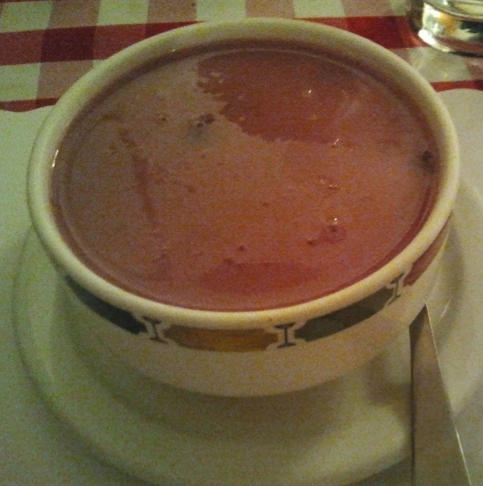
Wow.  I don’t even know how to start this post because I still can’t get my head around this.  Cold fruit soup?  At first I thought that perhaps the name didn’t translate very well from Hungarian.  But it does.  “Leves” means soup.  And then I thought, well, okay, this is just an unfortunate instance of poor naming that doesn’t really capture the essence of the food itself.  But it kind of does.  It actually is just cold fruit soup.  My relationship with this soup has run the gamut of emotions, from total revulsion to piqued interest to disappointment, and finally to indifference.

 Although I had all the opportunities in the world to try this soup during my many sojourns in Budapest, I never did.  The reason should be fairly self-evident (it's marketed as cold fruit soup), and I long considered it amongst the most depraved of all Hungarian inventions--of which there are many, and if you ever have the pleasure of meeting a real-life Hungarian, they will undoubtedly list them all for you.  I have never considered food to be a meaningful way by which to engage with a culture, but every time I was reminded of the existence of cold fruit soup, I had to stop and wonder what kind of miseries a people must endure to bring them to this dish.  I imagined a starving family, huddled together over a small fire in the midst of a harsh winter, with nothing to eat but some left-over fruit preserves from the fall and doing what they had to to survive.  The image did not appeal to me.
Okay, well, here it is.  The blobs are chunks of cherry.  At first I was pretty excited because I thought it would be like
the chunks of cherry in Activia yogurt (JLC: if you're reading this, hi!!), but it was not like that at all.

I also could never quite understand when one is expected to eat this soup.  I get the impression that it is often served as a main course, but because it's cold and because it's made of soup, it didn't make any sense.  Shouldn't it just be a post-meal dessert or a poor substitute for ice cream?  It really should not be a meal unto itself.  I don't know how many times I will have to say this in this post, but it is quite literally cold fruit soup.

By imagining how it might first have been developed and by trying to figure out when one is supposed to eat it, cold fruit soup slowly wormed its way into my brain, and I became obsessed with trying it for myself.  This was a pretty new phenomenon for me, because even though I am often intrigued by different foods, I almost never want to try them.  I'm not sure what made this instance different.  But I did try it.  I happen to live about two minutes from one of the few remaining Hungarian eateries in town.  I went with a real Hungarian, who described the soup as being "okay."  I was less generous in my evaluation.

Whenever I take a chance on a new food and try it, I always think it warrants a long post about my experiences.  But the bottom line is that this is a cold fruit soup, and it really doesn't warrant any discussion whatsoever.  Actually, I believe it is a disservice to culinary culture to give any more attention to this food than it deserves, which is none.  To quote one of my (few) instagram followers and real-life Hungarian:
There is nothing left to say about a food that is composed of three elements, the most crucial of which being "soup," and as nagymarcipan correctly pointed out, a soup must be hot and it must be savoury.  The Hungarian cold fruit soup is, then, composed of contradictions, and the second two elements--that it is cold and that is made of fruit--seems to negate the possibility that it is even a soup to begin with.  This food might have been more successful with me if it had been marketed as something else, like a compote or a sauce.  I mean, maybe you could drizzle this over some ice cream and it might be okay, but as it stands, this is not a food I will try again.

I'll leave off on one final note.  In John Hawkes' moderate masterpiece Travesty, the narrator claims that "the greater the incongruity, the greater the truth."  Before you get excited by the prospect that Hungarian cuisine can be justified by literature, it bears mentioning that this very same narrator makes this statement while recklessly driving a sports car at top speed through the French Riviera with the end-game of murdering his daughter and his daughter's lover (who also happens to be the narrator's best friend and the narrator's wife's lover) by crashing into a metre-thick cement wall, and is guided by the life-philosophy that willed destruction is the purest form of poetic expression.  So while Hungarian cuisine cannot be justified by this text, it nevertheless is hauntingly analogous to the current state of Hungary.  Sometimes unreliable narrators are the most reliable of all.

When I married a Hungarian I was not told
That one day I would eat a fruit soup served cold.
Had I known about this in advance,
I probably would have called off the entire romance. 

12 October 2013

The Plum

When someone suffers from Selective Eating Disorder like myself, it’s really rare to feel more or less indifferent about a food.  The majority of my posts on Food Thoughtz have been one extreme or the other: I either really love something, or I really, really hate it.  But plums are something that I just don’t care about.  I neither love them nor hate them.  I will eat a plum if it’s given to me, but I would never seek one out on my own.  I don’t think the flavour is great, but nor is it necessarily bad.  They’re kind of pretty, but not beautiful.  And they’re an awkward size.  I guess no one cuts up a plum like they might cut up a peach, but they’re also not really big enough to bite into like you would an apple.  If I believed that God made the world and everything in it, I would assume that He made the plum during a period of boredom and laziness, and then woke up the next morning and never thought of it again.

Whenever I see someone eat a plum, I think that person must have no passion in their life.  How could anyone be passionate about a plum?  There’s really not much there.  The skin has that weird sort of waxy look to it and the inside kind of looks like sickly urine.  If I ever went on a blind date with someone and asked them what their favourite food is, and they responded with “plums,” that would be it.  How could you spend the rest of your life with someone like that?  I bet their favourite tv show is CSI.  Like even now, in 2013.
I wanted to find a picture of me looking particularly indifferent or uninterested, and it
turned out to be the easiest task ever. MM was in the picture so I replaced her face with a
plum cross-section, partly because when I started googling plums, they were all these
red plums with red insides and nothing like these purple plums that I am used to, and I didn't
want my comment about unhealthy and slushy urine to be irrelevant. 

This is just to say
I did not eat
the plums
that were in
the icebox

I don't really like them
and anyway, 
they are yours
and I respect your property

I hope
they are delicious
so sweet
and so cold

09 October 2013

The Watermelon

In 2008, the Hungarian farmers took to their tractors and stormed Budapest with carts full of their own home-grown watermelons—but these watermelons were not for sale. Instead they took them to the doors of the supermarkets and dashed them against the pavement, destroying every single one.  It’s hard to believe that a Hungarian, who for whatever reason has such a strong emotional bond with the watermelon (so strong that watermelons are called “Greek melons” in Hungarian), would intentionally destroy a watermelon.  But it happened, and it happened as part of a protest against the supermarkets selling foreign (from Spain) watermelons for less than the Hungarian farmers could afford to sell them to the supermarkets.  I know: you’re wondering how it is that Spain is managing to undersell Eastern European farmers, but when you think about it, it just makes sense.

I don’t think I have ever been so divided on an issue,  or struggled so much to choose a side.  On one hand, of course I have to applaud the Hungarian farmers for destroying so many useless watermelons, but on the other hand, I want the big supermarkets like Auchan and Tesco to continue paying the farmers practically nothing in hopes that the farmers will eventually stop growing watermelons all together. How can one choose sides when both are heroes?

I first started working on this post last year.  I can’t remember when exactly, but it was when we were reading The Confusions of Young Törless by Robert Musil* in my Modernism class, because I then tried to model this entire post on Musil’s The Man Without Qualities, without having even read the Wikipedia entry on the book.  At the time, it really did seem to me as if the watermelon was a fruit without qualities (and I bet if given the chance, would have sex with its sister, probably the honeydew? And why not? The honeydew is a good looking melon. That instance of incest is, I believe, in The Man Without Qualities… not just a totally random mention of incest, although, I mean, there are worse things in this world than random mentions of incest. Like incest.)  After all, the watermelon kind of straddles the line between liquid and solid.  Like the tomato, it’s held together by a skin, but once you puncture that skin, there’s not much keeping the innards together.  But it would be a mistake to say that the watermelon is a fruit without qualities: it has several qualities, most of them bad. 
Here I am on the famed 2008 Victoria - Nashville road trip.  I think we encountered these
watermelons in rural Arkansas,which makes so much sense.

But let’s get the one good one out of the way first.  I will be the first to admit that there have been times when I wish I could join in on the summer fun of gathering around a platter of watermelon.  It seems like such a quintessential summer experience, and everyone is always enjoying themselves as watermelon juice dribbles down their chin. 

And now onto the bad.  But one time I did get in on it, and I hated it.  The texture of a watermelon has always been troubling for me.  I guess maybe it sort of reminds me of wet sand: it can be molded, but pressing a finger into it will make it sink down and lose its structure.  I didn’t realize how much the texture troubled me until I put the tiniest tip of a triangle in my mouth and immediately spat it out.  It was like… I don’t know, biting into that icy part of a slushy from Shell?  You know, what’s left after you’ve sucked all the syrup out?  It’s something that appears to have a certain form, but once you come into contact with it, that form totally evaporates?  Like if you bit a ghost.

Elizabeth Barrett Browning cradling
a slice of watermelon.
What else is wrong with watermelons?  Well, they’re cumbersome and large.  Or, when they’re not, they’re square, and just … no.  I don’t care one way or the other about modified foods, but I can’t get behind some scientist coming up with a way to make round fruit square to ease the packing and shipping process, just so that we’ll end up with even more watermelons over here. Related to their size, they’re always taking up too much room in a fridge, and there always seems to be a lot of pressure to “eat the watermelon” before it goes bad.  Why not just not buy watermelon?  Or, if you do, couldn’t you go halfers with someone else in town?  Oh, and they’re also at least partially responsible for watermelon-flavoured candies, which I’ve always hated.

I guess that’s about it.


*By the way, I loved that book.  I can’t imagine a book more perfectly suited to my interests: secret adolescent sado-masochistic gay sex in an attic at an all-boys boarding school in the remote outreaches of the Austro-Hungarian Empire?  Written by an Austrian and probably modeled on his own life?  Duh. 

Watermelon— How do I hate thee?  Let me count the ways.
I hate thee for thine depth and breadth and height
My arms can’t reach around, carrying thee is a plight,
And thine consistency is hard to place.
I hate thee, no matter what everyone else might says—

That “in the summer you are a most cool and refreshing bite.”

I hate thee freely, as is my right

I hate thee purely, in the face of others’ praise

I hate thee with a passion bordering on abuse

My hatred for thee is as strong and pure as others’ faith

I hate thee with a hate I shall never lose

It shall be a hatred of you whispered with my last breath

But if the Hungarian farmers should choose,

Then I shall only love thee after thine death!

Has anyone ever actually read this Elizabeth Barrett Browning poem?  Because this was the first time for me, and it’s really, really bad.