Showing posts with label Aesthetic Food. Show all posts

24 January 2015

The Grapefruit

If I was a committed reader of this blog, I might be inclined to believe that the writer of this blog probably hates grapefruit based on an earlier post on oranges. But I would be wrong. Because grapefruits are amazing and delicious. They suffer from many of the same shortcomings that oranges do: they have a thick skin that can be difficult to peel and they’re covered in the same gross layer of pith, and at the end of the day, they just might not be worth the effort. But where grapefruits really depart from oranges is that they don’t taste gross like oranges. They’re also called pamplemousse in French (pronounced: pample-moose).


It’s true: grapefruits are a frustrating and fickle fruit, but that’s why the loving women in your life prepare them for you. One time, as Christmas holidays were coming to a close, my mum cut up and peeled (including every single trace of pith) four grapefruits for me to take back to Montreal. I foolishly left them in my carry-on luggage, and a particularly harsh airport security person tried to take them away from me. I can only imagine that this security guard had a complex because she was a woman working in a man’s world. Thankfully, a more level-headed male security guard stepped in and appealed to the woman’s internal mothering instinct, and argued that my poor mother had probably spent hours slaving over these grapefruits, and wouldn’t it be a crime if I couldn’t take them home with me? The harpy relented and I boarded the plane, grapefruits in tow. 


One of the weird things about grapefruits is that they’re simultaneously one of the most beautiful and one of the most vile and repulsive foods on this planet. There’s something about the colour and those little moist globes of flesh that appeals to my sense of aesthetics. But on the other hand, those beautiful little globes of flesh also kind of look like literal human flesh (that has possibly been boiled or is for some other reason blistered?) or maggots or maggots that have eaten so much human flesh that they’ve turned a pinkish colour because they are engorged with blood. Sometimes I really like to push myself and actually try to hold that disgusting image in my head as I eat grapefruit, but it doesn’t even matter because it tastes so good that the thought of stinking, rotting corpses animated by so many swarming maggots doesn’t even put me off. 


I also used to really like Western Family Pamplemousse pop, and then I thought that Western Family stopped being a thing. I recently found out that is still very much a thing, but I don't think they're still producing the pop. Or else they are. I don't have access to Western Family in Ontario because Ontario is probably the very worst province in all of Canada. 

A pinwheel of globular drops of dew
Tinted a beautiful salmon hue?
Or a frenzied maggot feast,
Glutted on the recently deceased?  

04 October 2014

Armadillo Potatoes

This afternoon I read an article that someone posted on facebook about how you're eating food wrong. There was a picture of this delicious potato that looked like an armadillo. I was intrigued and needed to try it. I went out and bought potatoes. I tried it. And you know what? I'm not doing it wrong. I have been eating potatoes correctly my entire life. These armadillo potatoes weren't that great.

They ended up looking pretty good though, right?


Basically I just sliced them up as best I could while ensuring that each slice was still connected to the body of the potato at the bottom. Then I brushed them with olive oil because I got a free pastry brush on the street about a month ago. Then I sprinkled kosher salt on them (admittedly too much). And then I popped them into the oven for what felt like eternity, but was realistically more like an hour and a half, which is still way too much time to spend preparing a potato.

I think one of the reasons I didn't really like these potatoes (but don't get me wrong, I obviously still did really like them; they just weren't as good as pan-fried potatoes) is because I'm not all that crazy about olive oil. These potatoes might have been much better if I painted them with butter instead. I don't know. In the end they kind of just tasted like exactly what they are: potatoes painted with olive oil.

They also seriously took way too long.


Tonight I fashioned my potatoes like armadillos
Nothing relevant rhymes with "armadillos."

NB: I have labeled these potatoes as "Food I Have Tried But Would Not Try Again." Obviously I have so many more potatoes ahead of me in this life time. They just probably won't be these armadillo potatoes.

26 April 2014

Oranges

When I was eight my mum put sliced oranges in my lunch. This must have been the first and last time she had ever done that. When I tried to eat them, I was only able to suck out the juice, but wasn’t able to tear the flesh from the skin. What was left were pulpy and stringy stalagmites, rising up from the orange peel. It was embarrassing and I have never tried again.

But even if I had been able to successfully eat an orange, I still don't think these are for me. I have never been particularly fond of orange juice, and have especially always really hated the pulp variety. I can’t stand orange flavouring in things—least of all chocolate or desserts. For some reason I've always found a zest of orange peel somewhat nauseating. I don't even remember being particularly fond of the bit of orange that I did manage to tear free that one time when I was eight. Which reminds me—of course that one time in grade 3 was hardly the only time I've ever tried an orange. I have had oranges plenty of times in my life, but always cut up in some sort of fruit salad. I think my mum used to put it in with our fresh cut up grapefruits in the morning.

This brings up the most horrifying part of any orange: the pith. It's supposed to be good for you, but I'll be damned if it's not the most vile and bitter part of any fruit known to man. The only explanation for the existence of something so gross is that it's a defense mechanism against consumers. Listen to nature, you guys. This is the orange's way of telling us that we should not be eating it. Look, I get it. From a distance, oranges are beautiful: they are perfectly round and bright orange—why wouldn't we want to eat this delicious looking specimen? But when you finally manage to peel back the tough skin, rather than the revelation of a delicious fleshy-fruit to be eaten, what we get is all the reason we need to abandon this as a food.

It is a bit embarrassing to admit this as a former English student, but I don't really like Jeannette Winterson. I read The Passion and didn't like it even though everyone else does, but bravely I forged on and read Oranges Are Not the Only Fruit. The novel achieves title while the protagonist is in hospital, and her cruel evangelical mother doesn't visit her and only sends oranges upon oranges. Finally the protagonist tells her mother that "oranges are not the only fruit." We should imagine that she is also saying "this is not the only life" and that we should all canter off to the city and become lesbians. Or we could accept that she's really only talking about fruit and was correct in stating that oranges are not the only fruit, and with so many other options under the sun, why would we settle for this difficult and disgusting citrus abomination?

Somewhere between the pith and the pip
The orange fruit lies:
Brightly coloured; its flesh a-drip...
But the taste of the flesh does little to disguise
The ever-present,
The always-unpleasant,
The bitter reality of the pith and the pip.

13 March 2014

Marzipan

I will be the first to admit that I don’t really know what marzipan is, but here is what I do know: I know that it’s sometimes hidden inside of what would otherwise be delicious chocolates; I know that it’s sculpted into elaborate cake decorations; I know that Hungary has dedicated an entire museum to it; and I know that it is made of a ground almond paste, with probably a few other ingredients like sugar and, heaven forbid, coconut.*

Based on this limited yet totally sufficient body of knowledge, I can conclusively say that while I will never eat marzipan, I am kind of drawn to the sculpted figurines.  And herein lies the problem: I don’t particularly like it when I am attracted to one aspect of a food (usually its form) by repulsed by another (usually its taste, or function**). 

Binaries typically provide a great and totally reliable lens through which to view the world, they provide structure and meaning in our lives, and most importantly, they can be used to unpack our troubling relationship with marzipan.  One way to apply the system of binaries is to consider the binary of function/form (even though “form/function” sounds better, I purposely put function before form so you can see how it’s privileged over form).  See how that worked?  Easy as pie!  These days it’s very en vogue to deconstruct binaries—or at least to talk about it a lot—but what these genderqueers don’t realize is that binaries are one of the most useful tools at our disposal when faced with a troublesome entity like marzipan.  If you want to deconstruct something, deconstruct some marzipan and throw out that almond paste.
Ugh. I don't even care about this picture. This entire post fell apart for me in a really big way, actually. If I didn't
value quantity so much more than quality, I definitely would not be posting it at all.

Even though we’ve already agreed that function eclipses form, it’s still worth talking about these confectionary creations because some of them are really elaborate.  It’s possible that I am so fascinated by marzipan sculptures because they come pretty close to that cartoon food realm that I am so enamoured by.  They’re not quite there only because they kind of remind me of claymation, which I am not really into.  They also kind of remind me of those little toys or figurines… I don’t know what they’re called or even how to describe them.  A lot of girls had them when I was little.  They were usually a cute puppy dog and were coated in a soft fuzz.  They also had a weird smell to them, always.  Does anyone know what I am talking about?  I hate those things and have always found them somewhat nauseating. Oh! Here’s a link to them! They are disgusting.

Ugh.  Okay.  Well, that tangent just made it more difficult for me to explain why I do kind of like marzipan aesthetically.  I guess maybe it has something to do with the craftsmanship.  I have no idea how they’re made, but I like to imagine it’s a process similar to blowing glass, which is one of the most fascinating things I’ve ever seen in my life. What I might be realizing through the process of writing this is that I actually do not like marzipan in any capacity. The idea of eating it is, of course, revolting. It must be way too sweet and have grains of sugar and also it’s almond paste. I also don’t understand what happens to a large marzipan sculpture once it has serve its purpose. Surely no one is going to eat 10lbs of marzipan. Do Play-Dough rules apply? Do you just try to separate the colours as best you can and stuff it back into little canisters for next time? I don’t understand. Everything about marzipan seems disgusting and deceiving and wasteful.

Worth mentioning is that at some point in the recent past, there was a rumour of marzipan-made  tiny babies circulating around the internet.  I have no idea how I missed this.  Although it was all a hoax, the truth is perhaps even stranger than fiction: these fit-in-your-palm sculpted newborns are actually created by a Powell River-based artist and sell for over $100, and worse yet, people actually buy these things.  At least one person in this world must have paid money for one of these little gremlins!  Anyway, it got to be enough of a problem that the woman had to include the question of whether or not these things are made from marzipan into her FAQ section.  Even though this marzipan baby myth was debunked, the threat remains.  Marzipan sculpture technique is progressing so rapidly that I fear that one day these will be a reality, and someone will pay money to adorn their baby shower cake with.

Sorry you guys, didn't mean to get up your hopes,
But that miniature basket of fruit is a mazipan-hoax.
Don't gobble up that decorative cake topping in such haste!
Don't you know that it's actually made of almond-paste?


*Update: apparently there is no coconut in marzipan, but if there was some, I really would not be surprised.  The same kinds of people who are into marzipan are probably into shredded coconut.  I have no basis for that accusation, but I’m still pretty certain it’s true.


**One might argue that the function of a food is nourishment, but when you’re dealing with marzipan… come on.

27 January 2014

Pasta - Part I: An Introduction

Dear readers, you might be in for a long haul on this one.  One of the good things about being a picky eater is that on top of avoiding a bunch of really disgusting foods, you will likely become really passionate about the food you do like.  Pasta is one such food for me, and you guys, I really love pasta. 

Probably more than any other food type, pasta has remained the most reliable across time.  I’ve made similar statements about rice and potatoes—both of which are major staples in my diet—but neither have proven to be as consistently delicious or trustworthy throughout my life has pasta has been.  When we would go out for dinner to a restaurant when I was younger, plain pasta with butter was almost always not only a viable option, but one that I took extreme relish in.  There has only been one exception at the Sheraton Hotel in Spokane in which I didn’t get the pasta dish I expected (I touched on it briefly in a Dear Food Thoughtz post), but I see no reason for rehashing that one particular anomaly again here.  As I grew older and as my tastes evolved into the perfected and crystalline state they are today, I began to experiment first with plain tomato sauce and later with bolognese.  Actually, now that I think of it, there was a second incident in which I accidentally ordered a pesto lasagna not realizing what it was, but I take full responsibility for that mistake, and because it was a lasagna, it’s beyond the scope of my present purposes.
You know, I’ve always thought that the Catholic belief in transubstantiation was a bit farfetched, but I’ll be damned if pasta doesn’t transform into something divine when cooked.  Is there a more convenient food on this earth?!  It can be stored forever in its dry form,* but boils into perfectly soft and starchy entity in a short period of time (much shorter than rice, which shares the same storage benefits, although for some reason I always think a mouse will get in there).

  Its quick prep time and long shelf life make it perfect for round-the-clock feasts.  For whatever reason, I have a really hard time measuring pasta quantity, but it ultimately doesn't matter because if you cook too much you'll eat it anyway because it's delicious, and if you cook too little it only takes about 5 minutes to make another batch.

Another great benefit to pasta is that the possibilities of different pasta shapes is limited only by man’s imagination.  To help alleviate the pressure of choosing the best pasta shape, I have compiled a non-exhaustive list of some of my favourites (as well as some of my least favourites), followed by a brief brand sampling and some of the ways that contemporary health crazes have sought to degrade this noble food.  This post has been divided into three parts because it ended up being approximately 4,000 words.

*Here's a fun fact about me.  When I took the Food Safe course offered at Selkirk College in Grand Forks, I scored about 99% on the exam.  The instructor went over the exams and explained any of the questions that people got wrong.  And then she came to the one question that I got wrong, which was a multiple choice question about what food poses the greatest risk when raw.  The possible answers were things like meat, vegetables, fruit, whatever.  But pasta was also an option, and it was the option I selected.  My reasoning was that everyone knows that raw meat can be dangerous, but no one would suspect it from pasta.  So I actually selected pasta, and I got it wrong.  The instructor wasn't even willing to go over that question for the class because she assumed someone had just accidentally circled the wrong answer. 

Pasta - Part II: Different Types of Pasta

Spaghetti: Spaghetti is what most of us have in mind when we think of pasta, and with good reason.  It’s quick to cook and it provides an excellent base for sauces.  Wrapping it around a fork is both fun and challenging.  Although it lacks some of the qualities of other pastas, such as crevices for storing sauce of cheese, it more than makes up for this because not only can you often trap sauce or cheese between the layers of pasta as you wind it around the fork, but because you never have to grab the pasta with the tines themselves, they're left free to pick up meat clumps.  Spaghetti provides a great opportunity to choose your own pasta-sauce ratio. 

Vermicelli: Some of you might find this hard to believe, but there was a time in my life when I wasn’t willing to eat spaghetti and would only eat vermicelli.  I’m not sure what I was thinking, but I guess I thought that spaghetti was too thick and too dense—essentially that it was too much pasta.  It’s really strange to realize that I thought this way because it’s not like I was pairing it with anything else at the time except maybe some parmesan cheese. 

Spaghettini: But then things got even worse when I went down another size to spaghettini.  Have you ever eaten spaghettini?  It’s really skinny, but I used to love it.  And then one day my mum overcooked it into a big mushy blob and it made me so sick that not only could I not eat it at that point, but I would never be able to eat it again.  I love having spaghetti bolognese, but I honestly have no idea what it would be like with spaghettini because I can’t go near that pasta again.  Overcooked pasta is bad at the best of times, but when you’re cooking a pasta as fine as spaghettini, you really must remain vigilant because if it’s overcooked, you might as well put it straight into the garbage.

Fettuccine / Linguine:
I have no use for this pasta.  I can’t figure out why certain dishes require this type of noodle, but I don’t eat those dishes and I can’t imagine how this pasta could benefit me.  I don’t know anything about the history of pasta, but these noodles have always seemed like a totally unnecessary evolution of spaghetti.  Like one day a group of people were sitting around together and one of them said, “You know what would make spaghetti even better?  Flattening it!”  And everyone became really enthusiastic because it did seem like a good idea, but once it was done, no one could figure out how exactly it had improved on anything at all and eventually it was relegated to the sea food dishes because the only person stupid enough to eat sea food (in general, but here specifically with pasta) is also stupid enough to think that there is a benefit to a flat noodle.

My life will never be any better than it was at this
precise moment.
Radiatori: I have tweeted about this pasta before, and I stand behind that tweet: radiator pasta is, hands down, my favourite kind of pasta.  There is no wrong way to eat this pasta.  If you have it plain with a little bit of butter, it’s going to be great because droplets of melted butter will melt into the folds so that when you bite down, it will squirt out into your mouth.  If you have it with just melted cheese, it’s also amazing for the same reason that the cheese will melt into the folds.  I don’t know how serious you guys are about melted cheese on hot foods, but it’s really important that the food that you’re melting the cheese onto is porous or has folds so that there’s somewhere for the cheese to go.  There’s nothing worse than investing a lot of energy into grating cheese only to have it end up as a lump at the bottom of the bowl.  But if you pick the right base food, that cheese will coat it and seep into it, and it will be the best thing you’ve ever had.  The same goes for bolognese sauce, although admittedly bolognese is the most forgiving.  Even with a pasta like spaghetti, which doesn’t have any pockets to hold butter/cheese/sauce, the sauce is still going to coat it.  And if you’re twirling it around  a fork then you can usually trap some of the sauce between the coils of pasta, so you really don’t have to worry too much about your sauce-to-pasta ratio.  The main benefit of radiator pasta over other forms is that because of their ruffled and folded edges, radiators typically manage to have the largest surface area, which means there’s more to be covered by sauce or cheese.  But it also means that it’s dense, yet airy.  This is probably the best quality a pasta can have, and one that is shared by rotelle, fusilli, and rotini.  Radiator is the best at achieving this delicate balance by far, and that is why it is my favourite pasta.
  
Rotelle / Wagon Wheels This is probably number two on my list after radiator.  I love this pasta and I don’t know why!  There is definitely something magnetic about it because one time my niece was eating them and accidentally dropped one on the floor.  She was just little girl and I don’t know how much floor-dirt babies can eat, so I sacrificed the noodle to the garbage.  But then she had a major meltdown and refused to eat anything else, and eventually I just took her out of her high chair.  The first thing she did when I turned my back was go straight to the garbage, fish out that one noodle (it was literally in a garbage can, sitting amongst garbage), and pop it into her mouth.  And then she just stopped crying.  I realized at that moment that although my niece and I have almost nothing in common (she won’t eat potatoes), there is a little bit of me in her because losing even one wagon wheel pasta is a huge tragedy and it’s definitely something that warrants a tantrum.  But what makes this pasta so much better than others?  I can’t say for sure, but I suspect it has something to do with its wheel shape (duh).  What I mean is that when you consider a wagon wheel and how the spokes are there to maintain the circular shape and ensure that the wheel doesn’t just collapse, then you’ll understand what’s so great about this pasta.  It’s really sturdy, but because it’s also soft pasta, you exercise so much power over it.  You can break it at will!  One of my favourite things to do is to push a full wheel up to my top front teeth, hold it in place, and then burst my tongue through the spokes.  Admittedly this pasta is not the best for sauce because there’s not much to hold onto, but it still works really well with butter or cheese.  Obviously all pasta is good with butter, but the shape of the wheels gives something for the cheese to melt onto and stick to.  Unlike something like penne, where the cheese typically just slips off, the various spokes provide the cheese something to hold onto.  If you’re really lucky the cheese might melt over the entire surface of the wheel so that you end up with something that resembles a drum.

I put zero effort into this one, but it was still a great excuse to remember that 2008 USA Sista Road Trip.


Conchiglie / Shell Pasta: There was a time in my life when I refused to believe that anything was better than shell pasta.  It was probably around 2007.  By then I had probably already had radiator and wagon wheel, but for some reason shell pasta was just really doing it for me.  Shell pasta has a lot of really great design features (actually it only has one, but it’s really great).  Because it’s shaped like a shell, it functions as a pocket  to catch whatever you drape over it—it’s like eating a spoonful of spoons, but the spoons are made of pasta and are edible.  One minor complaint about shell pasta is that it can sometimes be difficult to spear them with your fork, but it’s not difficult enough to stop you from enjoying this fine pasta.  Life is always placing obstacles in your way, and you just have to learn to overcome them.

Conchiglioni: For anyone who doesn’t know, conchiglioni are those giant shells that you’re supposed to stuff with something.  You probably can’t eat them plain, although I have thought about it.  I’ve thought about these giant shells a lot, actually.  Whenever I am in the pasta aisle I spend a lot of time staring at them and daring myself to buy them, but I haven’t taken the plunge yet.  I’m waiting for someone to stuff them with spaghetti sauce, grate some cheese on them, and pop them into the oven to bake. *cough*  Probably delicious, right?


Here is some penne that I ate one
time. It's totally smothered in cheese.
Perfect midnight snack.
Penne Rigate: Penne is a difficult pasta for me and I never really know how I feel about it.  One thing that I definitely do not like about penne is that it takes a lot longer to cook than any other pasta I typically eat.  The pay off, I suppose, is that penne is a lot meatier than other pastas so it makes sense that it takes so much longer to cook.  Penne is a perfectly acceptable pasta choice, but because there are better shapes out there, it’s not one I often go for.  If I do have penne, I typically have it plain with cheddar cheese because I don’t think it’s really a sauce pasta.  Because it’s a hollow tube it seems like there’s a lot of potential there to catch sauce or cheese, but it never really works out that way.  It should go without saying that the only penne worth eating is rigate.  I can’t imagine anyone ever opting for the smooth penne.
*NB. I didn't mention penne lisce because I can't imagine anyone even eats that. 

Macaroni: Macaroni is another kind of pasta that while I really like, I don’t actually eat very often.  It never seems worth buying macaroni because the shape just isn’t as good as other pastas.  I usually eat them as the pasta component to macaroni and cheese, but just because they’re the expected pasta to have in this dish, that shouldn’t stop you from experimenting with other forms, too.  Shell pasta is particularly good in macaroni and cheese, and I bet wagon wheel or radiator would be amazing as well.

Orzo: What the hell is orzo?  Rice-shaped pasta?  I hate it.  In general I’m not a big fan of mini-pasta (there are also tiny shells or those star-shaped things), but orzo is the absolute worst.  It’s like a bunch of slimy maggots and has neither the good qualities of rice nor of pasta.  One time I had to eat it and it felt like reverse-vomiting.  Maybe you’re thinking that all eating is reverse-vomiting, but this actually felt like someone recorded a video of me puking up rice and then played it in reverse.  It felt like watching that.

Fusilli: This is the most under-appreciated of all the pasta shapes that I eat.  I really love it, but for some reason I don’t buy it very often and I certainly don’t praise it as much as I should.  It has a lot of the same benefits as radiator pasta because it has a lot of surface area as well as nooks and crannies for sauce and cheese.  Radiator is better only because it has a more satisfying texture to it, partly because there’s more ridges to it, but also because for some reason it’s just better if it’s slightly undercooked.  For some reason I think this has to do with it being kind of a cube-shape, but I can’t justify that logic in anyway.

Rotini: This pasta is possibly slightly better than fusilli even though they are very similar in shape.  The benefit is that rotini is slightly tighter, so it’s denser to bite done on, but there’s enough space between the coils to give the pasta nice bounce.  Again, I don’t buy this pasta nearly as often as I should.

Farfalle / Bow Tie: I’m all for novelty-shaped pasta, but this just doesn’t do it for me.  It doesn’t have enough body to it.  It's like cutting a square from a sheet of lasagna noodles and twisting it.  The little gathering of pasta in the centre is the only thing that gives this pasta any sort of shape, and I hope that by now that you have realized that one of the most important qualities a pasta can have is good dimensions.  Farfalle just doesn't cut it, but I think I have seen it used in soup a few times, and that would probably be okay if you're into that kind of thing.  

Lumache / Snail-Shell: This is another pasta shape that I don’t have too much experience with, although I have nothing against it.  Now that I’m thinking of it, maybe I should buy a bag because it seems like this pasta merges the best qualities of macaroni with the best qualities of shell pasta.  They would probably make an excellent base for macaroni and cheese.  So if anyone is wondering what I want for my birthday (it’s coming up, or will be depending on when you’re reading this), you could get me a bag of lumache and I’ll try it out and get back to you.
Pasta art in Barcelona.
Lasagna Noodles: The only reason to eat this pasta is if you’re eating lasagna.  There’s no other way I’m going to cut my pasta with a knife.  Now might be a good time to mention that I absolutely hate it when people cut their spaghetti in half.  The same goes for people who break their spaghetti in half before cooking it.  I can’t even eat that garbage.  No one is more spoiled or coddled than me, but it takes a special kind of uselessness to only be able to eat spaghetti that has been halved.  You wrap it around your fork.  In hindsight, this note probably would have fit better under the spaghetti heading.

Tortellini: Olivieri tri-colour three-cheese tortellini is one of my major weaknesses.  I cannot exist in the same space as this pasta without eat it all up immediately.  Sometimes I am so full that I can’t move except to bring another forkful to my greedy mouth.  This pasta is delicious, especially when smothered in butter.  I went through a weird phase when I was really obsessed with grating parmesan on top of it, but I’ve since outgrown that and don’t like it at all anymore.  The orange colour is my favourite, but I had to find out the hard way that even though the green ones are my least favourite, if you remove all of the green ones, it really takes away from the overall experience.  I have never had any other form of tortellini and don’t even know if they exist.

Ravioli: I think I have had ravioli once in my life—in Italy (yes, Italy)—and it was fine, but ultimately unnecessary. 

Pasta - Part III: Brands, Alternatives, and Final Thoughtz

PASTA BRANDS:


Obviously there are numerous pasta brands out there, but here’s a small selection of what’s available.  These are the brands that I most often encounter.

Barilla: Even if barilla hadn’t made those weird anti-gay comments, they’re just not a very good pasta brand.  I haven’t bought this pasta very much in the past because it’s typically more expensive than other brands, but when I have, I’ve always had a hard time cooking it properly.  It seems to always be undercooked, and there is practically no window during which to extract the pasta at its perfect consistency.  And while I like the idea of pasta coming in the box, it usually find it to be more of a hassle than a bag.

Maybe it’s worth touching on the gay scandal that rocked Barilla in September 2013.  Essentially the Chairman stated that Barilla supports “traditional” families, and that if you disagree, then you can eat another brand of pasta.  And you know what?  If you disagree, you can just eat another brand of pasta.  It will probably help you to realize that Barilla does not produce a quality product.

De Cecco
:
This brand also comes in a box, but I still really like it.  I think the design is pretty good (Old Country, but not too Old Country).  I usually go for this pasta when I want to step up my game.

Catelli: Do not even talk to me about Catelli because I hate it.  Even if I didn’t hate it, it’s almost impossible to find a Catelli product that isn’t whole wheat or “smart pasta.”  I don’t know what the difference is between the two, but if there is one, I hate them both.

Primo: Of all the pasta brands, Primo is the one that I’ve probably eaten the most.  It’s cheap, most grocery stores carry it, and they’re usually the only brand that I can find in a generic grocery store that makes wagon wheels.

Italpasta: Italpasta has been my go-to brand recently.  It’s cheap and I think the quality is good.

PASTA DEGRADATIONS:


Look, if you can’t handle pasta, don’t eat it.  If it doesn’t feel good in your body, then maybe pasta is not for you.  If you feel guilty for eating pasta, then stop it.  But for the love of God, do not subject the rest of us whose digestive systems are tough enough to handle it to these revolting pasta-tweaks or pasta-alternatives.  Have you eaten whole wheat pasta?  It is disgusting.  It never cooks properly.  It’s brown.  That is not the pasta for me.  Brown rice pasta or black bean pasta, although I have never tried either, are similarly disgusting.  Is it even pasta?  I have no idea, but whatever it is, it’s clogging up my pasta aisle.  “Clogged aisles” is probably how you feel when you eat pasta, so stop doing it and stop searching for “healthy alternatives” that mimic pasta.

BOLOGNESE SAUCE:


I was originally planning to write a separate post for bolognese sauce, but because I’ve already mentioned it so many times throughout this post, it makes more sense to throw a little something together right now.
It’s hard to imagine that bolognese sauce is a fairly recent addition to my life.  I’m sure I had eaten it before, but I don’t remember getting serious about bolognese until that one time I was stranded in Ancona and there was nothing else to eat.  If you’re wondering whether it was particularly high-quality sauce because it was in Italy, the answer is no.  Italy, like anywhere else in the world, probably does have really good bolognese sauce, but I bet that what counts as “good bolognese” would be inedible for me because it probably includes fresh ingredients, and I can’t stand fresh ingredients in a sauce.  Bolognese sauce should always be made of canned crushed tomatoes and one small tin of tomato paste (do not consider getting any other form of tomato, such as diced or whole, because you’re going to have to puree them anyway, and you probably have a pretty cheap hand-blender that doesn’t puree very well, and you’re going to end up regretting your decision), the cheapest ground beef you can find (I always pretend that I like lean, but I actually like the regular ground beef because grease is so good in spaghetti sauce), one onion, some garlic, and then whatever spices might be available to you.  What I’m getting at is that the kind of spaghetti sauce I like is the sauce most readily available at fast-food stalls in ferry terminals in Ancona.  It is worth noting, however, that I have not limited myself to fast-food spaghetti bolognese.  Far from it, I actually orchestrated an elaborate marriage scheme in order to secure myself a life-time supply of spaghetti bolognese: I scoured the entire globe until I found the best bolognese chef alive today, and then I married them. (Boldog születésnapot, keleti szépségem.)

But it might be unfair to give Ancona full credit.  Previous to this experience in 2005, I had already started to get involved with baked lasagnas that were cooked with bolognese sauce and thankfully without ricotta cheese or bechamel sauce.  At that time--sometime during high school--I didn't consider the possibility of eating pasta with bolognese sauce.  It is typically the case with me that even though I like a certain kind of food in a certain kind of way, I am still unwilling to try that same food prepared in a slightly different way.  Even though lasagna should not be considered a direct cause of my later love of bolognese sauce, I think on some unconscious level it probably opened my mind to the possibility, and for that I am eternally grateful. 

Shall I compare thee to a summer’s day?
Thou art more starchy and more satisfying.
Summer is an unknown, but come what may,
Thou are steadfast and always appetizing.
Beads of melted cheese on thine ridges shines
My love for thee has not once been dimmed
Come hither! Prick thyself on my fork tines
Sauce, cheese, and pasta: mine bowl hath brimmed!
My commitment to thee cannot be sway’d
When thou art absent I am at my low’st
Accept this sonnet as my love display’d
I hope the gesture will not go unnotic’d
So long as men can breathe, or eyes can see,
So long lives thee, and thou give life to me.

14 November 2013

Lucky Charms

I have always loved Lucky Charms cereal — presumably just like every other child always has because it’s not even cereal, just marshmallows and sugar-coated crunchy-pieces that pay lip-service to the idea of “cereal.” When I would have a bowl of Lucky Charms, I would spend twenty minutes painstakingly picking out and eating the cereal bits until I was left with a bowl of marshmallows. The appeal of eating the marshmallows on their own has always been that the marshmallows are firm in their structure, but offer no resistance when you bite into them. There has always been a bit of a thrill in biting a marshmallow and half, and then examining its cross-section. Sometimes I would put a marshmallow—usually a red balloon, because they were my favourite—in my mouth and suck on it until it disintegrated. It’s a different experience than letting chocolate or a popsicle melt in your mouth because you can actually feel individual bits of sugar coming loose from the balloon until nothing is left. These two approaches to eating the marshmallows is contingent on their dryness.
Here's a screenshot of a picture I uploaded to Instagram of the first bowl of Lucky Charms that I ate after buying the
box, including a caption lambasting all of the fools who have eaten Lucky Charms with milk.

Here's a picture of what's left after
picking out the cereal bits.
One time, I think in the summer of 2006, I spent an entire day eating all of the cereal bits so that I could make a ball of all of the marshmallows in a single box of Lucky Charms and bite into it like an apple. It once occurred to me that I should just pick out the marshmallows and throw out the rest, but I realized that one of the best parts is the delayed satisfaction of eating all of those marshmallows all at once. This method of eating Lucky Charms taught me that if you work hard for something, the payoff will be that much sweeter than if you just go straight for the reward. For the record, I have not carried this life philosophy over to any other aspect of my life.

I typically always ate cold cereal dry. Rice Krispies is probably the only cold cereal that I consistently ate with milk (always with sliced up banana and a bit of sugar), and to this day, I have never had Cheerios, Golden Grahams, or Honeycomb cereal in milk. The thought of cereal and milk never disgusted me, but I was always certain that it would take away some crucial element from the cereal. I thought of it as a practice that was widely accepted, but never closely examined. I have always thought that cereal is best when it’s crunchy and that its crunchiness was central to its very identity. While I had often entertained the idea of eating my cereal in milk, I never did because I have always been a firm believer in sticking with what you know and what you know you like. Even if something turns out to be not bad, why waste that one experience when you know for sure that it could be as good as it has always been? For the record, this is a life philosophy that I have carried over to every other aspect of my life.

You can tell this is a store brand cereal
because the flakes are a much lower
quality than I have come to expect
from the branded cereals.
Things began to change when I went to Europe—the land of self-discovery—in 2005. I bought an 8€ box of Special K Red Berries and I had it with milk. Although I had had Special K Red Berries without milk in the past and really enjoyed eating those dried strawberries, after having a bite of my friend’s cereal, I realized that the strawberries only improved when they were soaked in milk and had the opportunity to soften up a bit. It was also around this time that I made the crucial switch from skim milk to homo, and while I still prefer skim milk for drinking, homo really is the best when it comes to cereal or milk in your coffee. The next cereal I tried in milk was something like NesQuik. It went over really well because on one hand, it turns the milk into chocolate milk, and on the other hand, those chocolate balls were always too dense and too hard to really enjoy. The milk softened them up an appropriate amount.

Ever since, I have been on a bit of a cereal-with-milk tear. As I mentioned, I still eat cereals like Golden Grahams and Cheerios without milk, but I’ve introduced a lot of new and exciting cereals into my repertoire as well—all of which I eat with milk. Over the past few years, I’ve really gotten into Kashi, Vector, Raisin Bran and any cereal that has dried berries in it (Jordans Morning Crisp, Honey Bunches of Oats with Strawberries, or the store-brand take on Special K Red Berries).

Lucky Charms is something that I’ve eaten less and less of over the years. Every once in a while it will go on sale so I’ll pick up a box, but in general, it’s just not a part of my diet anymore. There are probably a few reasons for this. Part of it has to do with how expensive it is, but more importantly, having a bowl of dry cereal has always been a mindless snacking activity for me. I eat it when I am watching tv or doing school work. I don’t want to have to focus on what it is I’m eating, and Lucky Charms is a cereal that, if you’re eating it dry, you have to give it your full attention. So it came as a bit of surprise to me when I picked up a box at Metro the other day (it was on sale for $2.99, down from the usual $5.50), but I was really excited to tuck into it.

At first I ate it as I always have. I poured a bowl, painstakingly picked out and ate the cereal bits, spent some time appreciating the beauty of all the colourful marshmallows alone in the bowl, and then gobbled them up. R was in the kitchen with me at the time and mentioned that his parents would never buy him Lucky Charms, but that sometimes his grandmother would. When I said that I never eat them with milk, he said that he had always enjoyed them with milk and that he would try to eat the cereal bits first because they were best when crunchy, but that the marshmallows really improved when saturated in milk.
On the cusp of trying something new. I regret getting rid of that box
because I could really use a new toque right now.
And then something happened. I don’t know what. I wanted to try it. I poured myself another bowl, added milk, and prepared for the worst. My main concern was that I would have less control over the cereal once it was sloshing around in a bowl of milk. I wouldn’t be able to pick out the cereal bits very easily, and I knew that I would inevitably miss some. I knew, going into it, that there would be times when I would have to eat spoonfuls that contained both cereal and marshmallow, and although I wasn’t thrilled by the idea, something—some force outside myself—urged me on. It will probably come as no surprise that I liked it. I really liked it. I’m still not sure if I like it more than having it dry, but I do like it. I liked it enough to rush out and buy another box to do the whole thing over again.
Something changed in me that day. It wasn’t life altering, but more like a little sliver of doubt entering my consciousness. I was so sure about Lucky Charms. So sure. I knew how I liked it; I was so certain that it could never be better. I’m not sure that it is better, but I think it’s probably just as good. My approach to food has always been premised on a strict hierarchical system. There is a very small group of food that I like, and within that group, I have always been adamant that there is a singular best way to enjoy that food. Potatoes are best fried; pasta is best with bolognese; broccoli and cauliflower are best with cheese. There are, of course, other ways I will eat these foods. I like potatoes baked in an oven or mashed, and I like pasta with either just cheese or sometimes just butter, and I like broccoli and cauliflower steamed plain or with butter, or sometimes even raw. But there is always, always, a “best” way to enjoy these foods. What’s different about Lucky Charms is that I’m worried that I like them with milk as much as I like them plain.

What does that mean for me and my diet? What if postmodernist theory was right? What if there is no such thing as a singular truth? That it’s all a construction? That there’s more than one approach to something, and that one is not necessarily more valuable than another? It’s an exciting time in my life right now, but also frightening. Does my experience with Lucky Charms gesture towards a flattening out of my diet, a horizontal expansion that knows no bounds? And where will I go from here? How will I ever approach a box of Lucky Charms ever again? How will I know how to eat it? How can I ever be certain of what I want ever again? The future is marred by uncertainty, and I have never been more afraid in my entire life.
Ever since it happened, news has spread like wildfire throughout Toronto.


I've approached my diet with unflinching certainty:
Confidence in my taste is central to my identity.
To experiment with food was an impossibility,
And Lucky Charms with milk was an incomprehensibility.

That I liked it suggests potential dietary malleability,
And more frighteningly yet, that singular truth is a fragility. 
What if trying new things is within my capability?
Does this signal towards a new versatility?

12 October 2013

The Pea

Nothing else from my childhood elicited as much excitement and pleasure as the first ripe peas in the garden. My appetite for peas was insatiable. I keenly remember being woken up by my mother, cooing softly that the peas were ready, and then immediately devouring every last one of them. When all the ripe and passably ripe peas had been eaten, I moved on to the totally unripe peas, and sometimes just chewed on the empty pods. My left thumb was green throughout summer, not because I have ever had any inclination towards gardening, but because the process of popping open a shell and scraping out the peas into your open palm will invariably dye your thumb green.

No amount of words will ever be able to communicate just how much I love fresh peas from the garden.  I was tempted to record myself making frustrated grunting noises because I think that sound is probably the only thing that could accurately capture how I feel about peas.  But I don’t know how to do that.  And it also would be really weird if there were just sounds of my grunting floating around on the internet.  In lieu of that, here are some things I want to do with peas:

  • Collect a lot of peas—still in their pod—in a bag and sit down with them and eat them.  I want for there to be so many peas that it becomes a mechanized routine: select a pod from the bag; pop open with thumb and index finger; slide out the peas with my thumb and cup them in my hand; put all of them in my mouth at one time; discard the empty pod into the empties pile.
  • Shell a bunch of peas and refrain from eating them.  Pool all of the loose peas in a large serving bowl and then slowly submerge my hand into the loose peas and feel them slip through my fingers.  Then select one beautiful pea, and crush it between my teeth.  Then eat all of the peas in handfulls.
  • Get a large bowl of loose peas.  Put my lips really close to the surface of the peas and then suck them up like a vacuum cleaner.
  • Hold a bunch of peas in the palm of my hand, but keep my palm as flat as would be possible to still hold the peas.  Then eat them out of the palm of my own hand like how a horse eats things out of the palms of hands.

Isn't it crazy to think that I've never had a single lesson on Photoshop?
And that I don't even have Photoshop on my computer? Right?!

Recent scholarly pursuits have brought my attention to the play Woyzcek by Büchner. In it, the titular character goes insane and murders the mother of his child, partially because due to a scientific experiment, his diet consisted only of peas. I know that time is not on our side, but Büchner, are you seriously not reading this blog? Don’t you realize that a strict pea diet could only lead to a life of pleasure and unmeasurable happiness? Don’t you understand that to consume a pea is to conjure up all of your loveliest childhood moments and to journey back to a time when your only worry was awaiting the arrival of the next wave of ripened peas?

In part, I suppose, the play speaks to the dehumanizing effects of medical and military apparatuses—but at what cost? What of the harm done to the gentle pea in the process? In calling into question these governing institutions, was it really necessary to strip away the beauty of the pea and to reduce this once noble pearl of the garden to nothing but an irritable grain of sand that claws away at your brain until you inevitably murder your wife with a blade procured from a wily Jew and commit suicide in a swamp? Büchner, you monster: look into your soul. You will find that the problem is not medicine or science or the military; the problem is you.

It’s probably only fair to mention that the peas in Woyzcek were probably canned.  I mean, of course they were canned peas, right?  It’s just that I never even think of canned peas as even existing, because who even eats those? 

It’s also probably worth mentioning that when I talk about eating garden peas, I mean eating them fresh.  I’ve had cooked garden peas before, and they’re good—better than cooked frozen peas—but whenever I eat them I feel this heavy sense of loss.  They’re so much better fresh.


The oyster creates the pearl of the sea
But the pearl of the land is the ripened pea
Both are divine, natural treasures
Both bring to me the purest of pleasures
But the pearl is merely vanity,
And I must listen to my stomach when it instead demands—
The pea! The pea! The pea!

29 September 2013

EveryBurger Chocolate Biscuits

When I found these in an international food store (yes, in Lethbridge), they were nestled between two different kinds of ramen.  The only clue I had to go on was their name, EveryBurger, and that there were “two inside.”  But even these snippets of information seemed to raise more questions than they answered. 

I’ve never been seized so firmly by a desire, nay!, need, to know what something is.  And so in a moment of reckless passion, I purchased the only box of EveryBurger available in the store — possibly the entire world.

For a short time I worried they might be a savoury treat rather than a sweet one, or even a weird kind of burger-flavoured bouillon cube; they were, after all, in the ramen aisle.  When I opened the box, I discovered two individually foil-wrapped containers. Ah-ha! A portion of the mystery solved: the “two inside” marked on the box clearly referred to the number of packages, rather than the total number of EveryBurgers in the box.  My prayers were answered when I carefully ripped open the foil and slid out a plastic tray: the “burger” filling was undoubtedly chocolate; the bun was undoubtedly a kind of sweet biscuit (similar to the ChocoBoy mushrooms but denser, and because it had some sort of glaze on it, the biscuit was not quite as crunchy as the ChocoBoy) peppered with some other kind of sweet meant to represent sesame seeds.


It’s hard not to compare these EveryBurgers with the ChocoBoy mushrooms, and invariably the ChocoBoy mushrooms come out on top.  Like the ChocoBoy mushrooms, I really loved the shape of these sweet little snacks. As you can tell from the photos, they’re actually quite realistic, and although they were certainly tasty, it’s their shape that really sets them apart from other chocolate/biscuit combos.  But when it comes to munching pleasure, they just couldn’t compete with ChocoBoy.  The main factor is the quality of chocolate: ChocoBoy was simply better.  Of course the quality of chocolate is important when enjoying a chocolatey snack, but what really stuck out for me was the design.  EveryBurger just had too much biscuit, and the biscuit also wasn’t of the same calibre of ChocoBoy.  So the process of eating a chocolate mushroom that I laid out in the previous post and that was so enjoyable for me, just wasn’t there with the EveryBurger.  It felt like just eating a generic cookie.  Like one of those tea biscuits or something.

I don’t want anyone to think that I didn’t wholeheartedly enjoy these little baby burgers.  They tasted pretty good and their form really was divine.  I really took a leap of faith when I purchased them, but you know what, sometimes taking a risk really pays off.

I really struggled with whether or not to put these EveryBurgers in under the Cartoon Food Update.  After all, they really look like Jughead’s burgers—more so than the gummy burgers.  But I guess what stopped me is that now my idea of “cartoon food” as a genre of food is so wholly wrapped up in the idea of gummy food that I just couldn’t bring myself to include these chocolate and biscuit burger cookies.
Here's me immediately after I found the EveryBurgers.

UPDATE:

I now have a direct line to EveryBurger.  They can be purchased at the same Korean grocery mentioned in the post about chocolatey biscuits.


 Few things in life have worked me up into such a fervor
As these chocolate filled biscuits in the shape of a burger.
I didn’t know what it was, but I had to find out
Whether savoury or sweet, I had to eradicate doubt.
EveryBurger is not like every burger that I would eat
Their patties are chocolate—not made of meat.
But inspite of this flaw, they're still just as sweet.

27 September 2013

Cartoon Food Update

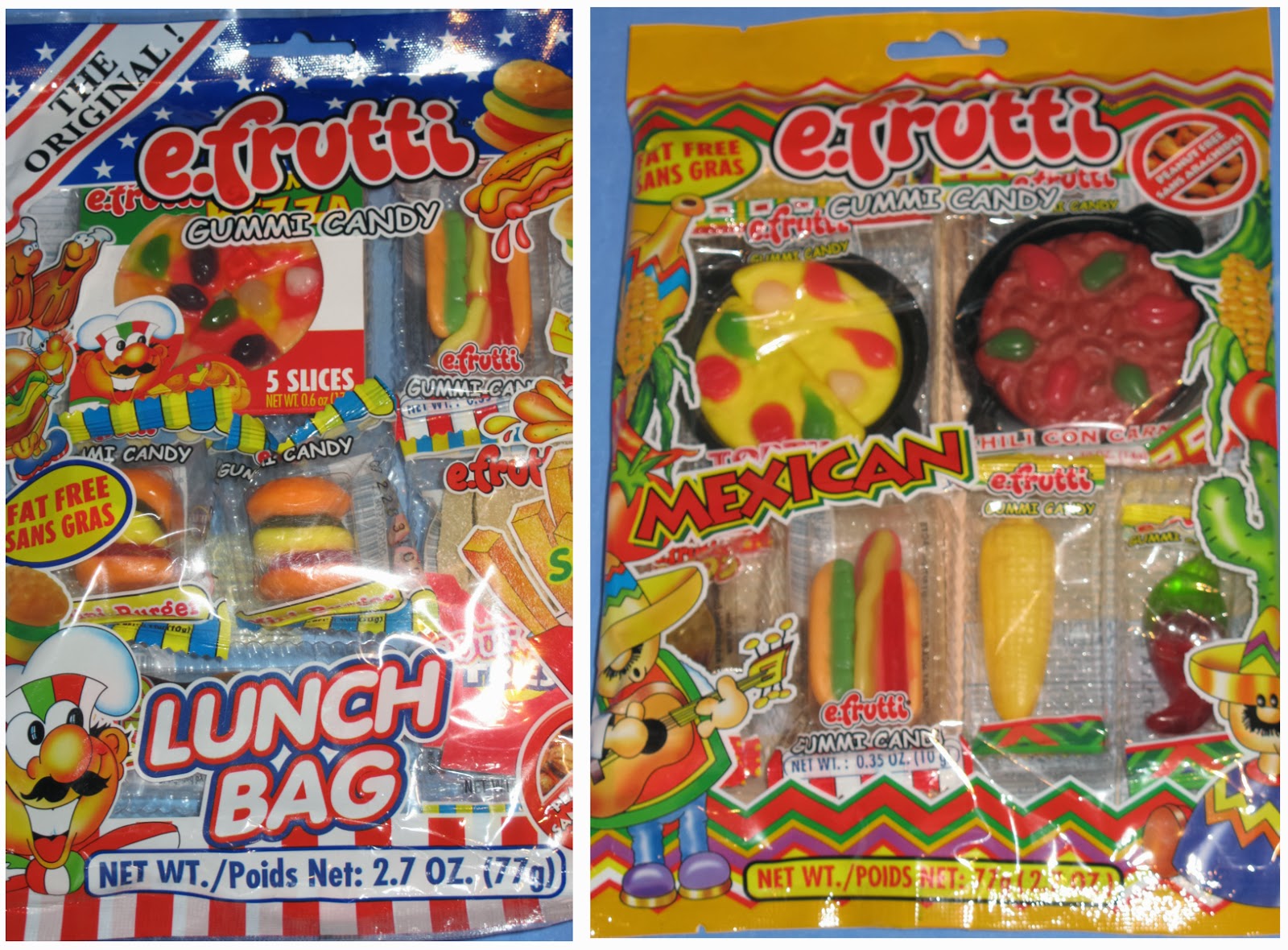
When my sista and I arrived in Calgary from Montreal, we drove through the hamlet of Nanton on our way to Lethbridge.  That there’s an antique-style candy store in Nanton comes as no surprise, but that they had one of the most well-stocked sections of gummy candy that looks like food was unexpected and ultimately bittersweet. 
Okay, so the selection wasn't that great, but still, I had never seen these before.  The "Lunch Bag" collection wasn't too
exciting because, with the exception of the hotdog and fries, I had already see all these candies before (there are two
Coke bottles obscured by the "Lunch Bag" text).  I have to admit that the fries were a really exciting find, though.  By
no means was the Lunch Bag collection a disappointment, but the Mexican collection was especially fun, if not slightly
disgusting. I'm not sure why there's a hotdog in there. It also comes with two corns and two peppers.

You know that feeling when something is so powerful and overwhelming that you’re certain it could happen only once in a lifetime?  And the whole time it’s happening to you you’re playing Celine Dion’s video of “A New Day Has Come” in your head and watching the camera pan around her as she stands in the clouds looking down on the world like the angel that she is?  But then that exact same experience happens again, and it almost cheapens the initial experience?  As if someone with a much weaker voice was now singing “A New Day Has Come”?  You know?  But at the same time, you’ve been here already, you know how great this can be, and to be lucky enough for something great to happen to you twice, let alone once, is really phenomenal and humbling.  These are the thoughts that were rushing through my head when I saw the different gummy candies available in the Nanton candy shop.

I don't want to spend any more time talking about these gummies, so I thought I would just provide a series of photos and perhaps make a few brief comments.

Here are the burgers from the Lunch Box series. Nothing we haven't all seen before.


The fries are new to me, however, and really appreciated.  One thing
that I think is really special about the fries is the sour sugar coating,
meant to stand in for salt.  Without it, they would have been just
gross strands of yellow gummy.  The cardboard fry container
is a really nice touch, too.
Here's the hotdog. I think it's a pretty decent representation, but sometimes these gummy
foods can really suffer when the makers put too much emphasis on condiments. 
I think I would have preferred just the hotdog and bun--just like in real life.


I stand by my original criticism of the gummy pizza, but one detail I really appreciate is that the pizza actually is in
five separate slices.  And, actually, that one mushroom looks pretty good.

Here they are all together, including the cola bottle which I didn't
provide an individual picture of because we've all seen it before.
Moving on to the Mexican collection, these peppers were probably the biggest
disappointment of the pack.  I'm not sure why. They felt like a lazy afterthought to me.
The corn was a really nice surprise for me. I really didn't see that coming.  I worried that I wouldn't enjoy eating
them because they were made of that weird marshmallow candy, but they were actually pretty good.
Now we're getting into the exciting additions to the Mexican collection.  This tortilla is pretty disgusting
to look at, but I'm not sure where the happy medium would lie between this and the pizza. The
pizza is way too busy, and as a result loses the simply quality that cartoon food needs in order to be
appealing.  But this tortilla is too plain.  I think that Trolli missed out on a really great opportunity to
make something special, and the vegetables are obviously way too globular.  That being said, without it,
the Mexican collection would have really been lacking.
Along with the tortilla, this Chili con Carne is the other big draw of the Mexican collection.
It's really disgusting to look at, but a neat detail is that it comes in a little plastic "cast iron"
serving pan.  I could not bring myself to eat this.  One lingering question I had after unpacking
the Mexican pack is why wasn't there a taco included?  But then I remembered that for some
strange reason, there is a hotdog, and now I am thinking that the hotdog was probably intended
to function as a taco.  At any rate, I think that was a pretty major oversight and lost opportunity.

26 September 2013

These Weird Chocolate Mushroom Shaped Biscuits

If the purpose of this blog is to create and maintain a catalogue of all the foods I have encountered, and a brief note on whether I will eat (or will eat again) that food, then let this post be one loud, resounding YES!!!

I bought these tasty treats in Lethbridge, Alberta.  I know what you’re thinking: Alberta? Lethbridge?  When did Alberta—let alone the rural southern part of Alberta—become such a trendsetter and the epicentre of novelty foodstuffs vaguely resembling non-novelty foodstuffs?  The easy answer is whenever the Real Canadian Superstore opened in Lethbridge, but the more accurate answer is whenever the Asian market found out about southern Alberta.


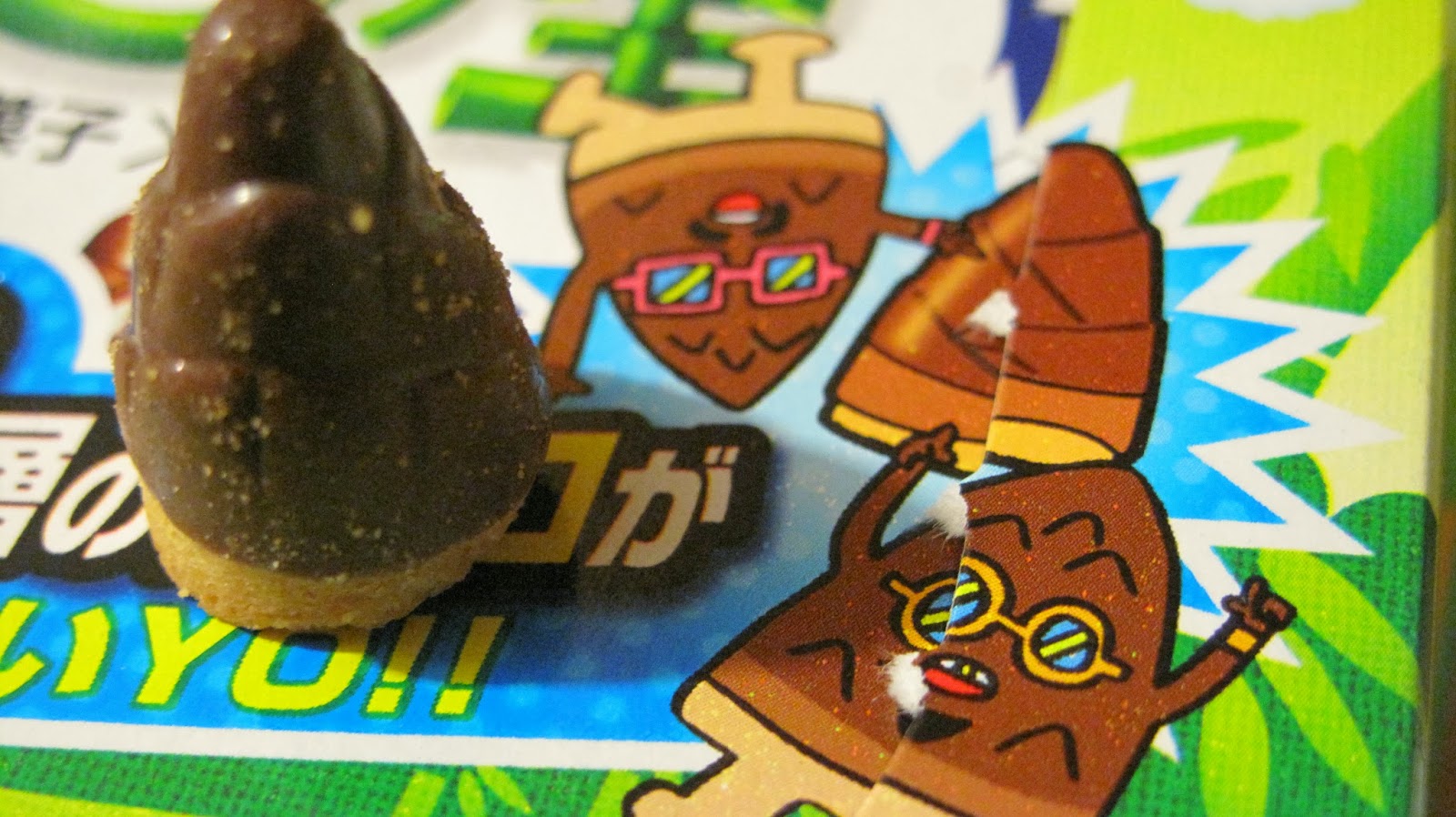
I was tempted to lump this, along with a few other recently discovered gems, under a generic “cartoon food update” header and be done with it.  But there’s something about these ChocoBoy chocolate mushrooms that sets them apart … and I think it’s the chocolate.  These biscuits really
don’t resemble food in the way the gummi burgers did, so I decided to treat them (along with the EveryBurger, coming up soon) separately.  The most important thing to keep in mind, which is something that I hope I stressed in the Cartoon Food post is that cartoon food (I mean that is onTV, not what you can buy in stores) sets a standard for that entire food.  For me, a cartoon mushroom must always be a white mushroom and always be on a pizza.  You know what mushrooms I'm talking about.

There are a lot of things I really liked about this snack.  For starters, I love the milk chocolate and biscuit combination.  It’s a pairing I really got into when I was in France—yes, France—and lived almost exclusively off of those biscuits with a thick layer of milk chocolate on top.   There’s something about the fusion of firm milk chocolate with crunchy biscuit that’s just … so … satisfying.  At first you might think the milk chocolate is too firm, but you would be mistaken.  Pushing down on that chocolately bulb is almost like plunging a French press: you get the same soft compression and slow resistance.  And just as you’re two rows of teeth are getting close to meeting, you snap the brittle biscuit because that tension—albeit slow, and albeit soft—has been building up and is finally released when it comes into contact with the biscuit. 

The second reason I really liked these choco-mushrooms is because they’re shaped like mushrooms.  In terms of balancing the biscuit-chocolate ratio, a mushroom design does make sense: it’s really nice to have all of the chocolate concentrated in one area so that you can decide which part, the chocolate or the biscuit, that you would like to really focus on and savour.  But on the other hand, isn’t it so weird to make a little cookie shaped like a mushroom?  And not even a normal white mushroom, but one of those weird, wild, really phallic mushrooms? Like, what a weird choice for a cookie.  But you know what? It works.  And it especially works for someone like me who would never actually eat a mushroom (or would I?).

The third great thing about this product is the packaging.  I remember going into the Shell when I was younger and being so jealous that they had entire box displays of Baby Bottle Pop or Ring Pop.  Until I realized you could just buy all that stuff in Costco, I really thought that it was a sign of success to have the display box.  These ChocoBoy mushrooms come in a similar display box, but obviously were not designed to be sold in the same way as Ring Pops (in part because there are too few in a box, but also because they’re all just loose in there and that would be disgusting).  At any rate, the packaging was a nice little bonus.  They didn’t have to do that, and you know, I really like when companies say to themselves (or so I imagine), “You know, we really don’t have to do this.  But I tell you what — I bet there’s a little girl out there who’s really going to appreciate it.”  (This is actually how I imagine a lot of businesses working.)  And this goes without saying, but the cartoon versions of the mushrooms on the packaging really wet my appetite.  At first I thought there was no way the real cookies would be anything like the depiction on the box, but then I opened the box and was like, wow, these cookies are really similar to this depiction.

Overall, this was a really positive experience for me.


UPDATE: 
A fellow food hero has already written about these and it turns out the ChocoBoy (a Korean company) chocolate mushrooms are a knock-off of the Japanese Kinoko No Yama cookies, which have been in circulation since 1975 and, according to the author, have been the leader in the "'sweets that look like mushrooms' market."  What is it with all these amazing food blogs lately?


FURTHER UPDATE:

After reading about an entire world of chocolatey biscuits that I didn't even know existed, I used the internet to track down a cache of Japanese snacks.  I discovered that the Korean supermarket a block away also carried Japanese products, and so I hotfooted it over and bought the following:
I also bought a box of the meiji Kinoko No Yama chocolate mushrooms, but they're not in the picture because I
gobbled them up immediately. A picture of the empty package will follow.  From left to right: some Japanese chocolatey biscuit in the shape of what I assume are pinecones (by meiji); some Japanese chocolatey biscuit in the shape of tree trunks (by meiji); a Korean chocolatey biscuit in the shape of koalas and called "Koala's March" (by Lotte).


And here's a picture of meiji's Kinoko No Yama, which I believe translates to "mushroom mountain."

Here are some pictures of the tree stumps:
The interior of the carton is similar to EveryBurger: two foil-wrapped plastic trays full of cookies.  The others only
haveone large foil pouch, which you will see later on.


Here's a closeup of the biscuits themselves.

And now the pinecones:


The opened package.
The individual biscuits.  These were my least favourite of all the snacks, and it definitely had to do with the biscuit
part,which was much more crumbly than the others. It almost had an artificial nutty taste.
The actual biscuit in comparison to how they are presented on the packaging.  I wish they would have included marzipan
facial hair and sunglasses on the actual biscuits.

Last but not least, Koala March:
And finally, Lotte's "Koala March," which I haven't tried yet, but
am really excited to open. Apparently all of the koalas are different,
and there's even an "appendicitis panda," although I believe
it is quite rare.

A brief note on my experiences: The link posted above to serious eats is a taste test between ChocoBoy's mushroom biscuits and meiji's Kinoko No Yama. The taste test revealed ChocoBoy to be the better biscuit, despite a general consensus that Kinoko No Yama is better quality. What sealed the deal in favour of ChocoBoy was the taste of the biscuit, which is a lot sweeter than Kinoko No Yama. My impression is that while both are great, I too must side with ChocoBoy. Unlike the taste testers at serious eats, I didn't really discern any difference in the quality of the two chocolates, but I definitely did prefer the ChocoBoy biscuit stems. One point in favour of Kinoko No Yama (although this might just be an issue of shopping) is that there were fewer broken biscuits.

Next I tried the tree stumps, which taste nearly identical to the meiji mushrooms. I love them for their novelty factor -- seriously, tree stumps? -- but ultimately I preferred the shape of the mushrooms when it comes to actually eating the biscuits. What I don't like about the tree stumps is that you pretty much have to take bites that are both chocolate and biscuit, whereas I like to be the master of my own destiny when it comes to what section of the cookie is in my mouth at what time.

Finally, I tried the pinecones and as I mentioned in one of the photo captions, these were my least favourite. The biscuit was decidedly different from the others, and I didn't enjoy it nearly as much. What I think I would have liked a lot more is if they had made the biscuit a hollow cylinder because I think I would really enjoy lodging the point against the back of my front teeth, and then crushing the pinecone by forcing my tongue into the hollow cookie.

I have yet to try the Koala March biscuits, but it is my understanding that they are merely the Korean version of the meiji pandas, which I have had and which I really, really liked. I've always been a fan of cookies that are chocolate pockets, which is exactly what these are. The added bonus is that each cookie has a printed image of, in this case, a koala. Apparently each koala is different, so I will be sure to update this post with some individual pictures of the biscuits themselves.

And finally, to close things out, here's the poem that was missing from the original post:

So you have a selective eating disorder, what could be worse?
What sins did your parents commit to burden you with this curse?


You won’t eat sandwiches, salads, or fettuccine alfredo.
You won’t eat red pepper, beet, cucumber, or tomato.
But do not despair; there’s more to this world.
There’s the entire Far East just waiting to be unfurled.
Korea has ChocoBoy, the chocolate-capped mushrooms
And Japan has Meiji, with its entire forest in bloom:
Mushrooms, and pinecones, and tree stumps — oh my!
A whole new world of chocolately biscuits for you to try!